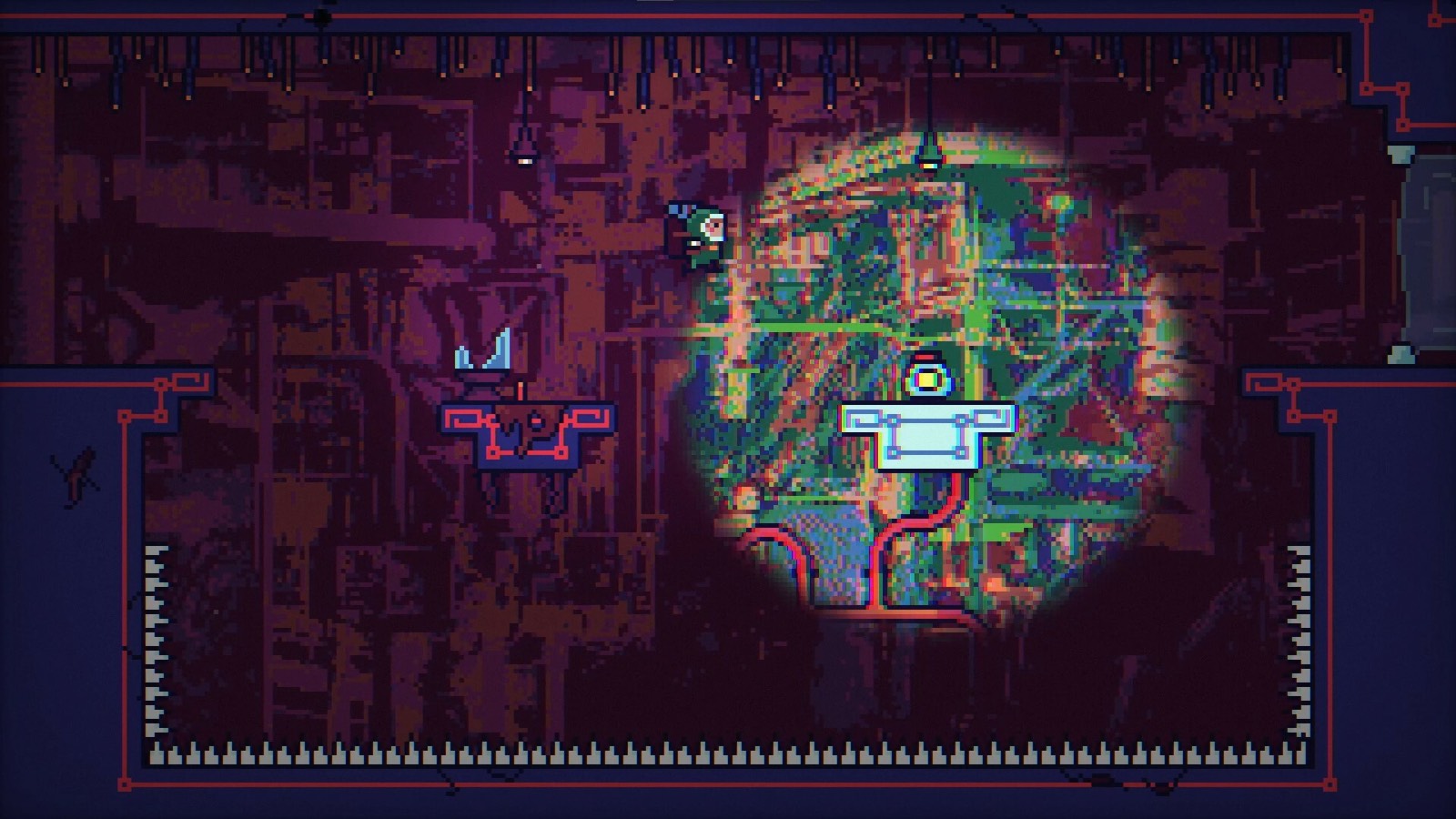
A white platform appears only where Backpack Boy's flashlight cuts across a ruined room. Its far end stops at the same soft, crooked edge as the beam. Move the light and the route has to move with it.
The game describes this as shining into the past. The sharper idea is spatial. The past is not a second room reached through a menu or a full-screen toggle. It occupies one patch of the room while the present remains visible around it.
The official screenshots show the boy aiming a narrow cone through dark machinery. Inside that cone, pale green walls, pipes, and platforms replace the rusted version of the facility. Outside it, the old room does not disappear. Both layouts compete for the same screen.
The Steam page calls the flashlight the first and most important tool in the backpack. A second tool, the lantern, uses the same power to punch holes between here and somewhere else. The original 2023 jam page called the idea mode swapping; the released game expands that prototype with new levels and mechanics.
A global switch would solve a different puzzle
A normal world-state switch asks a clean question: which version of the room should be active? It also hides half the evidence. Once the screen changes, the player must remember where the missing ledge, blocked corridor, or safe floor used to be.
Keeping the transformation inside a beam changes the question. The player can compare both states at once, but now has to consider where the body stands, where the light points, and which piece of the other layout is useful at that exact spot.
Backpack Boy gives the player a portable window rather than a binary switch. The flashlight can reveal one route without replacing the whole room. A platform in the past can become useful while the surrounding present still defines the approach and the landing.
The screenshots place lanterns on stands and platforms, turning the same visual rule into a hole that belongs to the room. That gives the designers two versions of the mechanism: a window the player carries and a window the level positions.
The beam has to draw a trustworthy border
The local beam keeps cause and result in the same view. The player does not need a before-and-after memory test to understand why a jump became possible. The altered geometry is visible inside the light, and the unchanged geometry explains why the beam has to be aimed there.
It also lets one room support a surprising amount of puzzle work. A ledge can exist in one state, a wall in the other, and the useful overlap can move without sending the player to a separate map. For a game that grew from a jam prototype, that is a productive kind of expansion: the original rule can create more layouts before it needs another verb.
The visual edge of the beam is soft, but a platform edge is not. If the player can stand on a surface only while enough of it is illuminated, the game has to make that threshold trustworthy. A missed jump should point back to a bad plan, not leave the player arguing with a blurry boundary.
Lanterns create another risk. A fixed hole between states can become an ordinary key switch if activation is the only decision. Their position, coverage, or interaction with the portable flashlight needs to alter the route; otherwise the mechanism loses the spatial authorship that makes the beam interesting.
Choose where the past begins
Backpack Boy is aimed at players who enjoy reading a room, comparing two layouts, and making one piece of impossible geometry appear in the right place. The design question for other small teams is precise: when a world state changes, should the player choose when it changes, or where?
Sources
Find Backpack Boy on Steam
See current screenshots, system requirements, and release details.