
A voice that gets smaller with distance
Most co-op games let friends wander apart while remaining perfectly present in each other's ears. Big Walk does something less convenient. Voices fade with distance, the environment changes how they sound, and a radio becomes useful because the person speaking is no longer beside you.
Crossing ground changes what the group can know and how they can call one another back.
Two to twelve players cross a hand-crafted world together. Nearby voices can fade, echo, or become muffled; radios introduce their own crackle. Players also have arms for gesturing and a collection of communicative objects: laser pointers, megaphones, flares, whiteboards, cowbells, and walkie-talkies.
A microphone is not mandatory. The official FAQ says text chat follows the same spatial features and restrictions as voice, preserving the rule for players who communicate by typing.
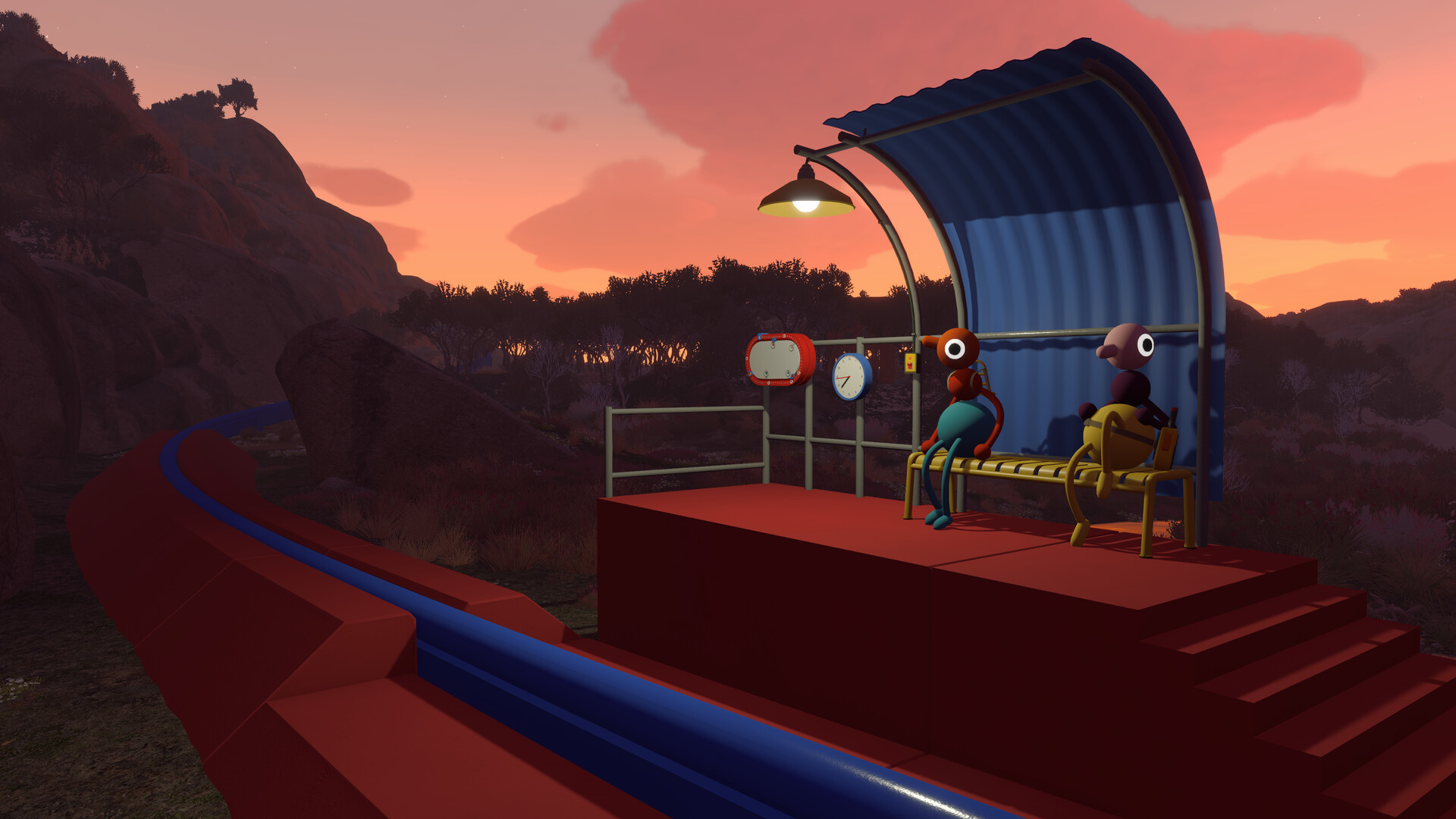
Communication belongs to the landscape
Always-on chat is efficient, but it sits outside the place being explored. A player can be lost behind a hill and still speak as if they were standing in the same room. The map separates bodies while the chat channel quietly erases that separation.
Big Walk needs getting apart, and finding each other, to matter without turning the adventure into a communications failure.
The game makes contact something players perform. A distant voice might be too faint, so someone raises a flare, writes on a board, rings a bell, or reaches for a radio. Conversation now has a position, a range, and a visible cause.
Because the same world contains puzzles, toys, and a route with an ending, communication is attached to a shared journey rather than placed in a separate social lobby.
Getting lost can be the point
The restriction could create stories that clean voice chat removes. Someone disappears around a corner. Later, a flare appears across the landscape and the group has to work out who sent it. The tools let players answer the separation instead of simply enduring it.
Text following the spatial rule is an important detail. It suggests the design is tied to distance rather than to one input device.
When separation stops being playful
A meaningful restriction can still be exhausting. Quiet microphones, hearing differences, or a group that wants reliable coordination can turn distance into friction outside the intended game. The text option broadens access, but it does not make every communication need equivalent.
The joke depends on separation feeling temporary. If a group spends more time repeating instructions than finding one another, distance stops creating stories and starts slowing the trip down.
Big Walk is likely to appeal to groups who enjoy getting distracted, losing the plan, and using the world to recover it. Players who want co-op communication to remain dependable and invisible may see the central idea as an obstacle rather than an invitation.
Sources
Find Big Walk on Steam
See current screenshots, system requirements, and release details.