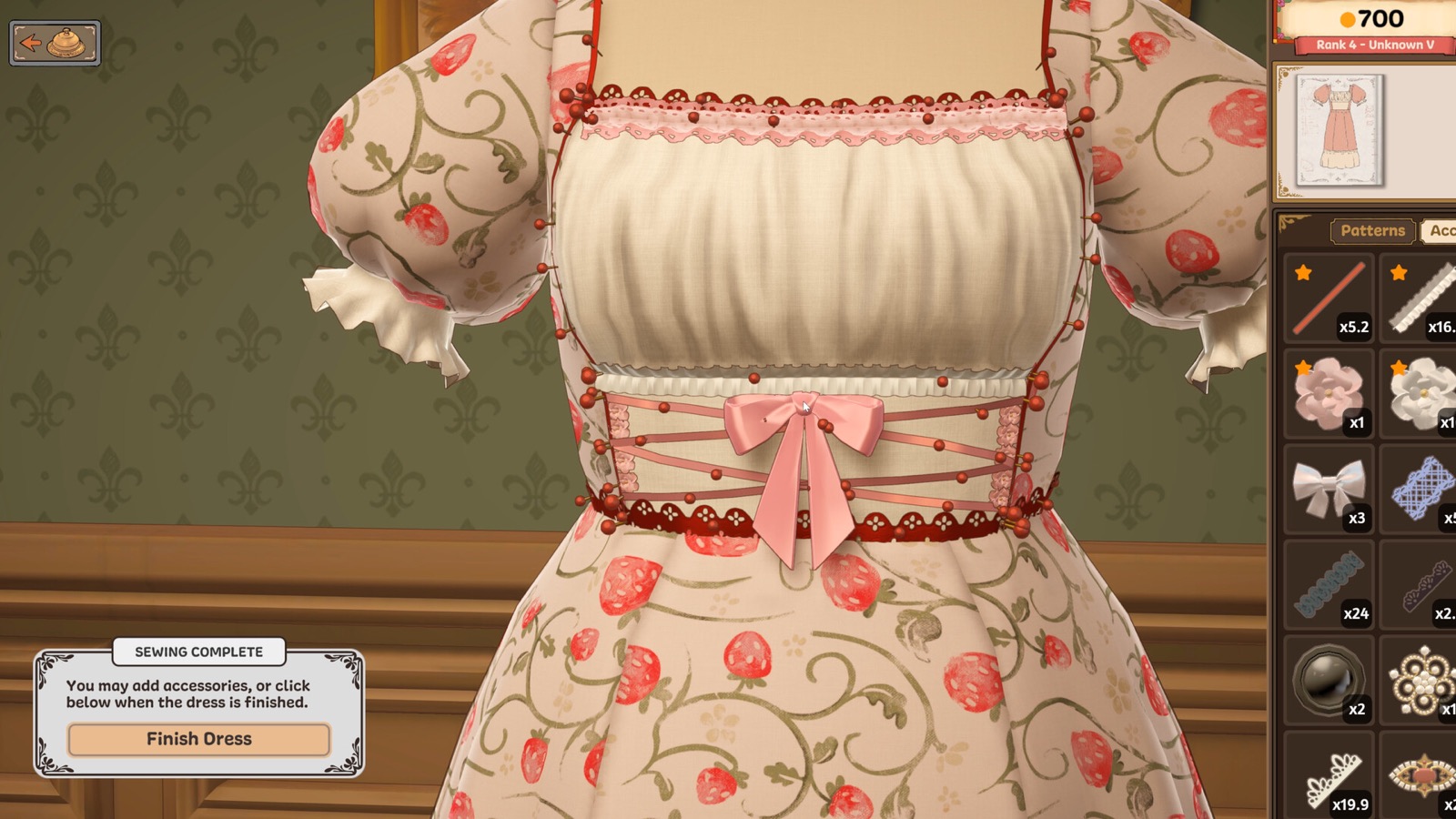
A dress-up game can hide most of its decisions in a menu. Pick a silhouette, swap a colour, add an accessory, and the result appears. Dressmaker starts earlier. It asks where each pattern piece sits on the fabric and carries that choice into the garment.
The Steam page is unusually specific about the consequence: aligning a pattern with the grain or cutting it on the bias changes what appears on the final dress. The cutting table is not preparation for customization. It is where customization begins.
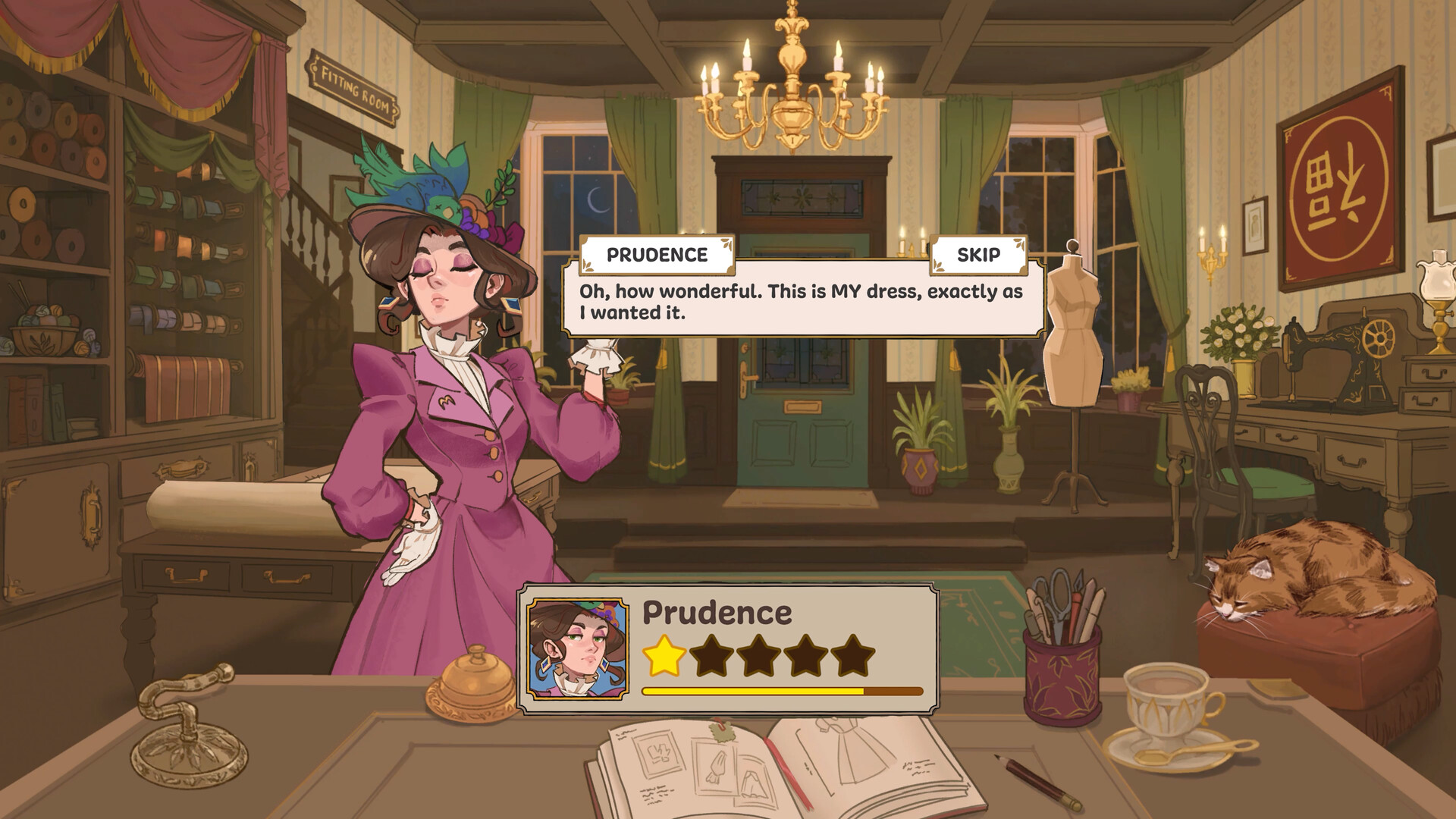
The player buys fabrics, sketches a design, arranges pattern pieces, cuts them out, previews the panels on a mannequin, feeds fabric through a sewing machine, and adds buttons, bows, lace, or appliqué. Customers bring occasions and preferences, while finished work can also be displayed and sold from the shop window.
Cozy Lives has kept the sequence close to real dressmaking without promising a complete garment simulator. The current store page says the chosen fabric for each panel, its position, and its orientation survive into the dress. The downloadable prototype was built first, and the team says it has continued revising the interface so returning players can understand the work without every action needing another tutorial.
The fabric needs to remember the cut
Crafting often becomes theatre around a result chosen elsewhere. The player clicks through cutting and sewing, but the important output was already fixed by a recipe or style menu. If the intermediate work cannot alter the object, repetition teaches timing rather than craft.
Dressmaking offers a better source of decisions. Fabric has direction. A printed motif can land differently across separate panels. Turning a piece changes how that material reaches the body. The difficulty is making those facts readable to someone who has never used a paper pattern.
Dressmaker preserves the history of the material. A panel remembers which fabric it came from and how it was laid out. The mannequin then gives that flat decision a body before the player commits to sewing. Decoration arrives afterward, so it can respond to the garment rather than substitute for its construction.
This also makes variation cheaper to understand. Two players can begin with the same pattern and make visibly different dresses without unlocking another base model. The difference comes from how they used the cloth. For a small team, one reliable material rule can produce more authorship than a catalogue of fixed outfits.
The strongest feedback is the finished panel itself. A stripe that turns, a motif that crosses a seam, or a contrasting fabric on one section can show the consequence without a score pop-up. The player can inspect the dress and know where the decision came from.
That makes the game's creative promise more concrete. Freedom is not only the number of available fabrics and trims. It is the ability to make a choice during construction and still see it after the object is complete.
When tactile work turns fussy
Tactile work can become fussy work. A player who understands the visual idea may still struggle to rotate, align, or guide a piece through the interface. If a small input error ruins a long commission, the game may punish coordination more than design judgment.
The team has publicly discussed making the interface easier to understand, and the prototype is explicitly unfinished. The full game's release build will have to distinguish a deliberate odd seam from an accidental control mistake. Helpful previews, repair tools, and readable consequences matter because the interesting choice is where the fabric goes, not whether the mouse behaved.
Dressmaker should appeal to players who want creative work to leave evidence on the object, including people more interested in construction than collecting preset outfits. Developers can borrow the underlying rule without copying sewing: if a crafting step belongs in the game, let the finished object remember what the player did there. Otherwise the step may be ceremony that delays the result.
Sources
Find Dressmaker on Steam
See current screenshots, system requirements, and release details.