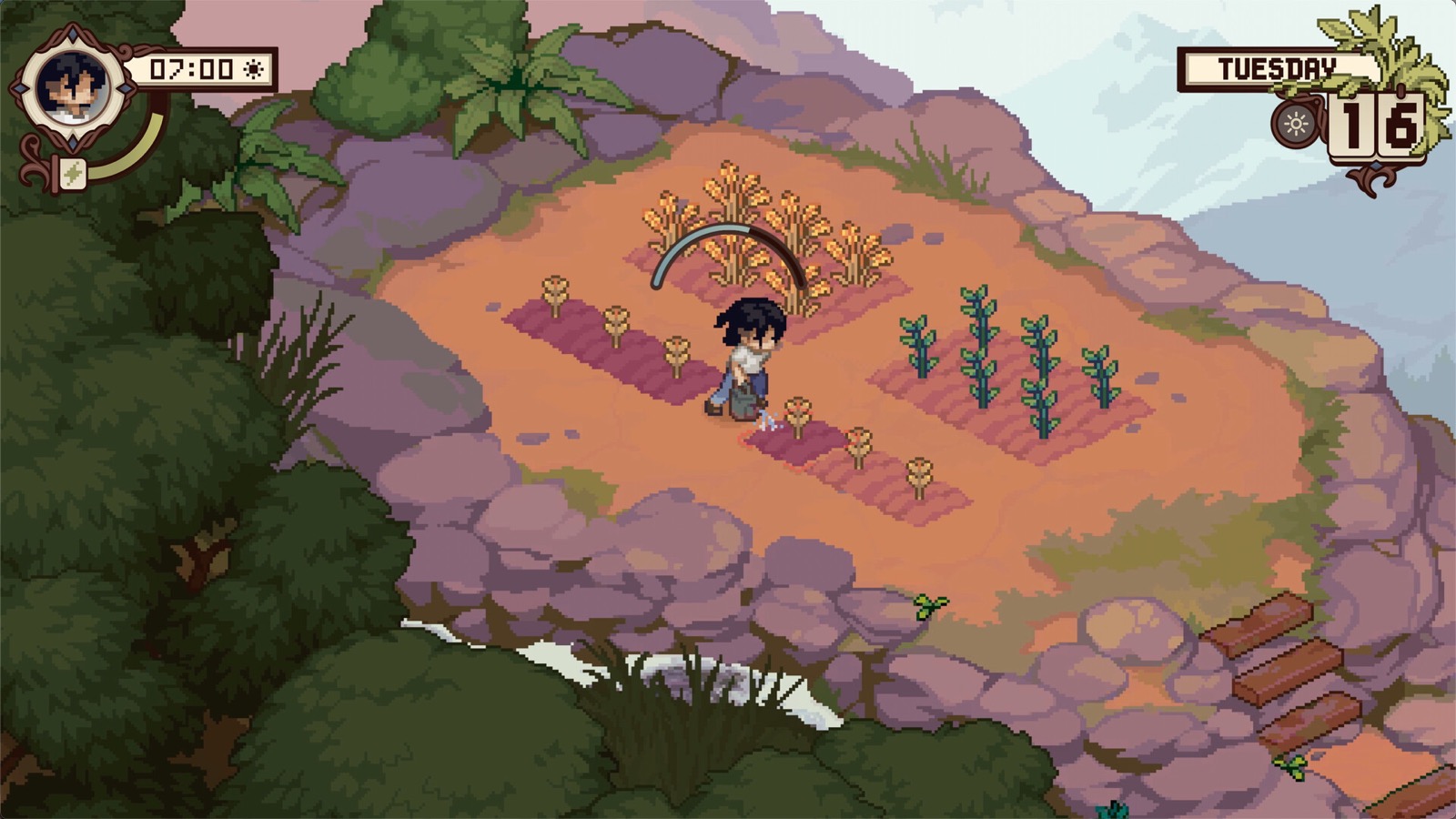
A farm grid usually announces itself before the player has touched a shovel. Grave Seasons holds it back. The town is drawn as a loose isometric space, and the squares appear only when farm work needs an exact answer.
That makes the grid feel less like the world's underlying truth and more like a tool the player takes out for a particular job.
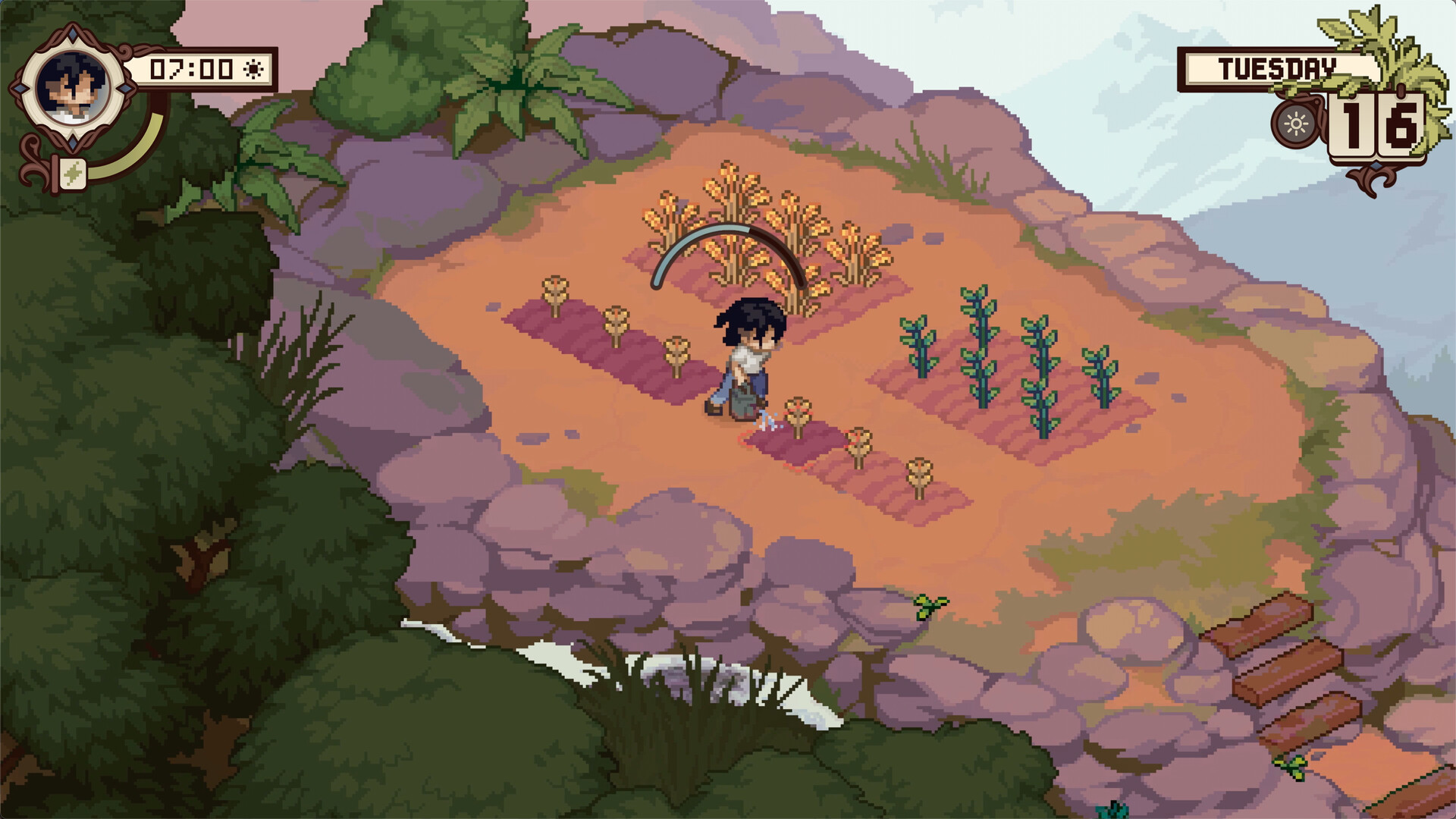
Perfect Garbage's August 4 development log shows a visible grid around the player inside farming plots. A target cell changes between white and red according to the equipped tool, available energy, and whether a seed belongs in that plot type.
Outside those plots, another grid stays hidden. The team says it checks nearby spaces for interactions that look close on the isometric screen even when their top-down coordinates do not line up. Farming and foraging look at the three tiles ahead. An approaching character can be detected across all nine surrounding tiles.
A painterly town still needs exact tools
Grave Seasons has two visual commitments that pull in different directions. Its town needs irregular scenery and asymmetrical set dressing. Its farming needs a player to know which piece of soil will be dug, watered, or planted.
Lock the whole town to visible tiles and the art starts serving the tool system. Remove tiles entirely and a missed action becomes hard to read. The player may be facing the wrong patch, holding the wrong tool, or standing at a distance that only looks correct from the camera angle.
The game splits those responsibilities. The visible farming grid appears where precision matters and reports whether an action is legal. The invisible grid makes interaction areas more forgiving in the rest of Ashenridge without drawing boxes over every person, tree, or object.
The tolerances also change with the task. A tool checks the space in front of the character. Conversation accepts approach from any direction. The rule follows what the player is trying to do instead of making every action obey one interaction radius.
This could let the environment keep its hand-placed look while giving repetitive farm work crisp feedback. When a cell turns red, the refusal has a visible location. When the player walks through town, that same support can disappear and leave the scene alone.
For a developer, the useful part is how limited the solution remains. A grid does not have to own the whole game to solve one spatial problem. It can be a temporary instrument, provided the transition into it is clear and the action behaves consistently once it appears.
The cost of changing spatial grammar
Context-sensitive help creates context-sensitive expectations. If a log can be collected from what looks like a generous distance but a crop requires a precise facing angle, the player may read the difference as unreliable controls rather than two intentional rules.
The grid also risks becoming a farming mode that feels detached from the town around it. Frequent flashing, snapping, or changes in reach could make the underlying coordinate problem more visible than the soil. The transitions solve the readability problem only if they stay brief. Frequent pauses across a full year could make the interface feel like an interruption rather than an aid.
This approach should interest players who like the clarity of tile-based farming but do not want every street and interior arranged as a board. For developers, the more useful question is not whether a game should use a grid. It is which actions deserve to reveal one, and how much tolerance the remaining actions need when the grid disappears.
Sources
Find Grave Seasons on Steam
See current screenshots, system requirements, and release details.