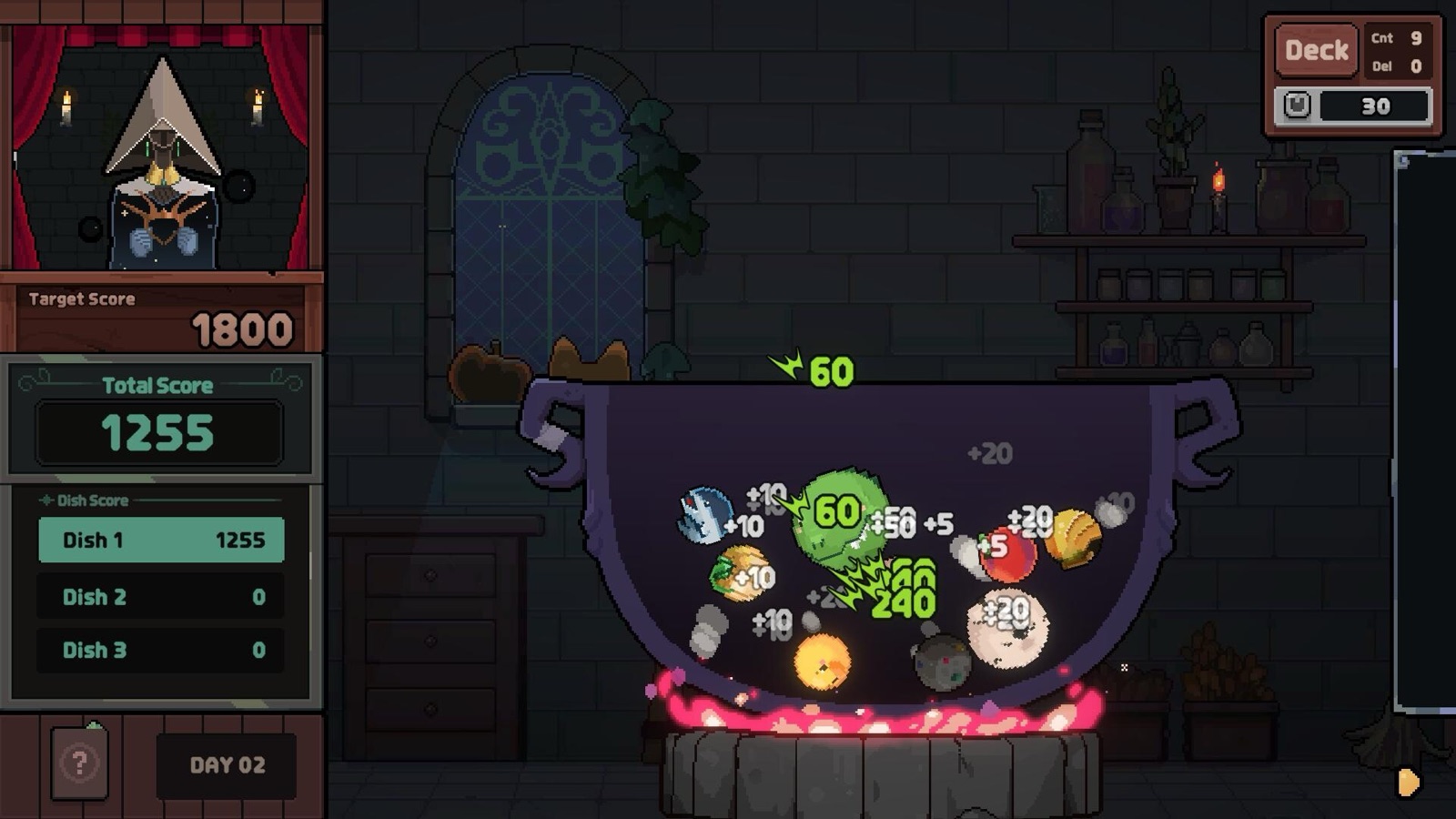
A deckbuilder usually lets the card explain what happens next. Kinny and the Cosmic Cauldron drops that certainty into a bowl. Ingredients tumble against the walls and one another, merge into larger bodies, and scatter score values across the cauldron.
The deck still matters, but it cannot promise the exact meeting. It supplies a family of possible collisions and asks the player to build for what might survive the drop.
Official screenshots show round ingredients collecting along the bottom of a wide cauldron while impact bursts and score values mark new contacts. The store page describes twenty ingredient types appearing across a run, random drops, merging, reactions, score targets, cauldron expansions, and Cosmic Relics.
Reward cards expose the rules behind the spectacle. An ingredient can carry base score, bonus score, tags, collision conditions, and combination effects. The run chooses which of those rules enter the deck, then the bowl determines which objects actually touch.

The deck and the bowl split control
Pure chaos would make deckbuilding cosmetic. A player could choose a careful set of ingredients, watch them scatter, and have no useful explanation for the result. Pure control would cause the opposite problem. Once every collision is placed exactly, the cauldron becomes a board with a decorative wobble.
The system needs enough physical uncertainty to create stories and enough stable information to support the next reward choice.
Kinny divides authorship. The player chooses which ingredient rules are likely to appear together. The simulation handles where the bodies settle, which pair collides first, and whether a reaction creates room or congestion for the next drop.
Score targets give that uncertainty a deadline. Clearing quickly can award cauldron expansions and relics, so a deck is not judged only by its theoretical maximum. It also needs to produce useful contact before the container fills with the wrong shapes.
The result can make a failed combo diagnosable at two levels. The ingredient rules may not support one another, which points back to the deck. Or the right ingredients may be present but physically separated, buried, or trapped, which points to the cauldron state. Those are different problems and should lead to different reward choices.
Physics also gives repeated ingredients a visible history. A merged body occupies a different amount of room. A crowded bottom changes the path of the next drop. The current dish remembers previous reactions without needing another status panel.
Was it the build or the bounce?
The distinction between a bad deck and a bad bounce has to remain legible. Post-launch hotfix notes say the team reduced cases of ingredients becoming stuck in the cauldron lid, then rolled back a related change. That rollback shows the cost of asking physical objects to carry a scoring system.
If collisions are too noisy, the player cannot learn from a missed target. If the simulation corrects every awkward state, the cauldron loses the surprise that separates it from a deterministic combo board. The result depends on how clearly each collision explains itself.
Kinny and the Cosmic Cauldron should interest players who like tuning a build and then watching it encounter a system they do not fully control. Players who want every combo to resolve from exact sequencing may find the physical variance frustrating. A missed target needs to leave enough evidence to tell a weak deck from an unlucky container.
Sources
Find Kinny and the Cosmic Cauldron on Steam
See current screenshots, system requirements, and release details.