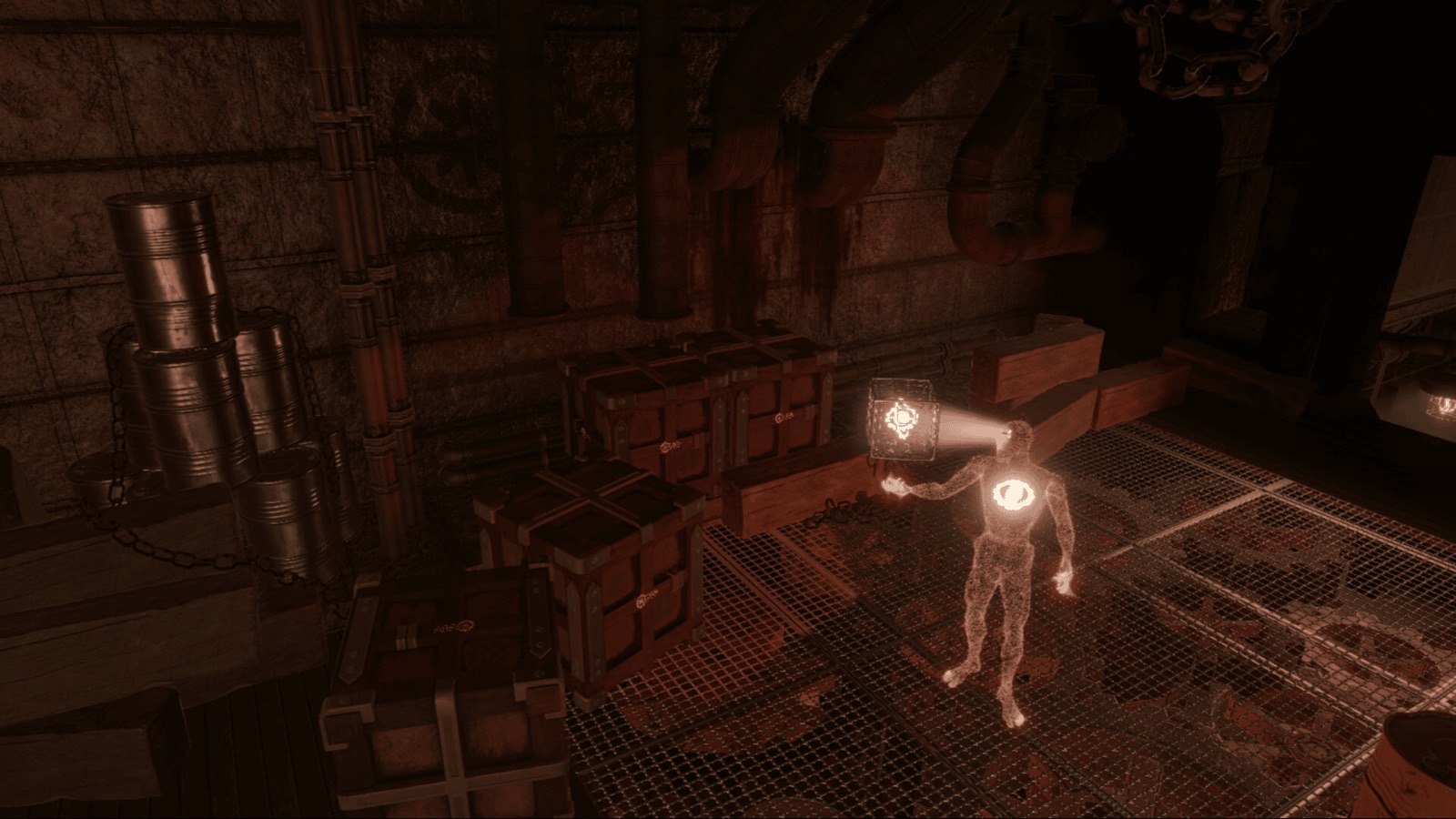
A bright cube throws a narrow beam across LIGHTPUNK's nearly black machine room. A human-shaped outline catches the light. The screenshot barely uses color, yet the beam reads like a rigid connection rather than ambient glow.
That line has a physical job. An S-8 Graviton grows when light reaches it, shrinks when the light goes out, and changes weight with its size. Looking at the useful object can change the object being considered.
The F-0 Flux does not hand the problem to a separate resize tool after it levitates the S-8. Light is the shared rule. It changes the Graviton's size and weight, can be absorbed and emitted by an L-3 Photon, and can open gates. The game is betting that one visible signal can stay readable across several consequences.
Vignette Games describes a world bound by laws of physics and says every motion has a consequence. Here that fiction has a mechanical point: light is not a layer placed over the room. It is one of the things the room obeys.
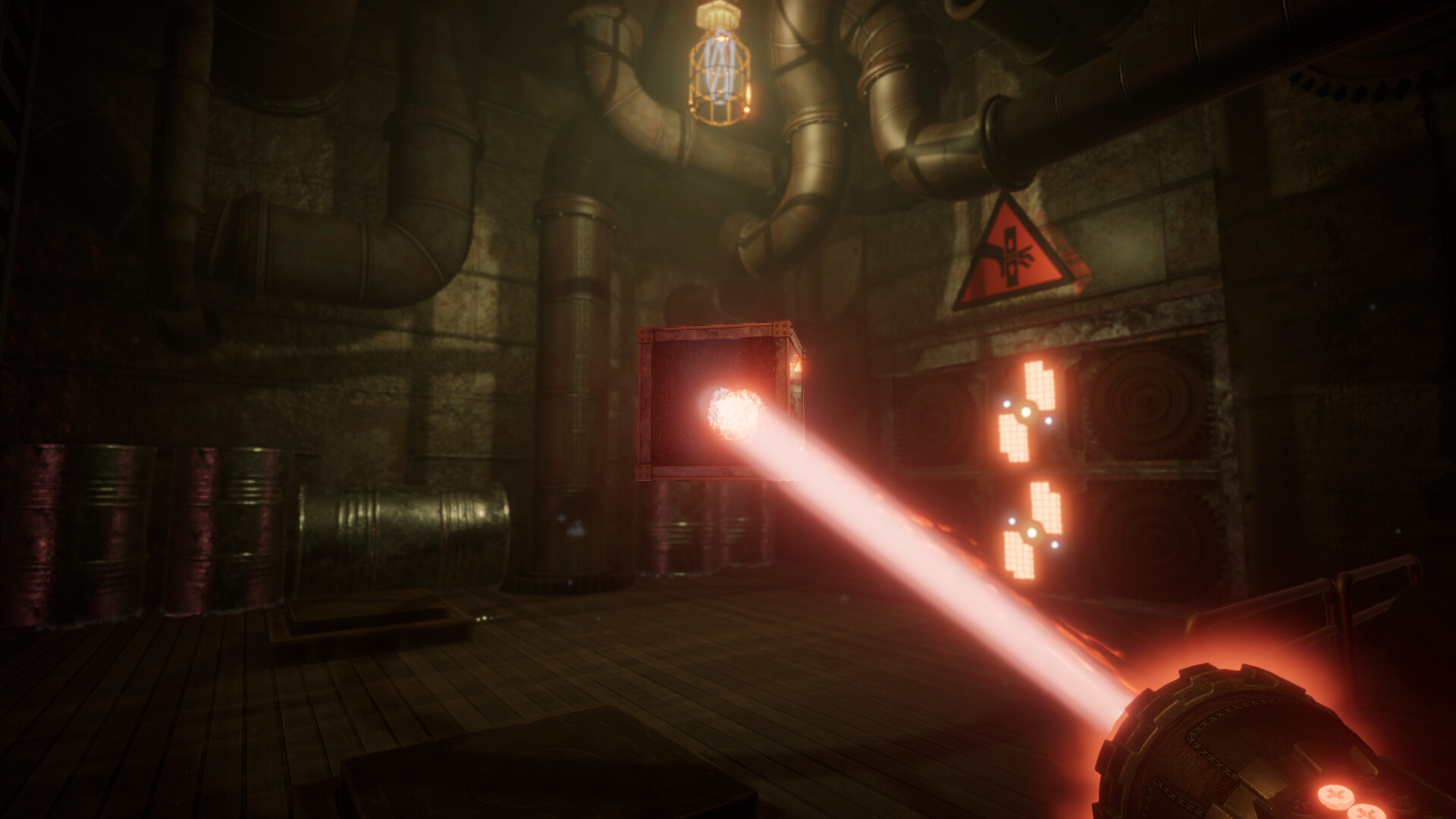
The beam does not wait for a second command
Most room puzzles separate reading from acting. The player looks for a ledge, studies a weight, then picks a tool. That separation makes a plan easier to form because observation leaves the board alone.
LIGHTPUNK removes some of that safety. A beam aimed at the relevant material can resize, reweight, or move it while revealing it. The object under inspection is already entering a new state.
Instead of placing those changes behind separate buttons, the game couples them to one visible cause. When the beam lands, the Graviton grows and its weight changes. When the beam leaves, the object returns. F-0 Flux supplies levitation, and the Photon can carry light elsewhere.
Darkness does more than hide the answer. It restores a physical condition. The room itself can show the comparison without asking the player to consult a mode icon or switch to a second inventory tool.
The beam is already the status display
The beam is already a status display. It identifies the object receiving the command. The object's changed size confirms that the command landed, and the resulting weight can matter to whatever machinery comes next.
For a four-person team, this is a bet on combination rather than expansion. A chamber can change which material catches the beam or which mass threshold matters. The Photon can move the same problem somewhere else. None of those relationships needs another button, but each one has to be readable through the beam.
Darkness has to report what changed
The same darkness that sells the premise can damage the mechanism. If an interactive surface is hard to distinguish, or the boundary of the beam is vague, a failed change may look like bad aim, the wrong material, or a physics bug. A system about light has less room than most games to be unclear about what is lit.
There is also a repetition risk. If each chamber asks only for a small box in darkness and a large box in light, the physical vocabulary collapses into a binary switch. Mass, levitation, stored light, and gates need to disagree often enough that the player is choosing a relationship rather than repeating an activation ritual.
Players drawn to first-person rooms that reward close inspection have a reason to watch LIGHTPUNK. The harder question sits with the beam itself: how many physical meanings can it carry before shining light stops feeling like an experiment and starts feeling like a legend the player has to memorize?
Sources
Find LIGHTPUNK: Law of Inertia on Steam
See current screenshots, system requirements, and release details.