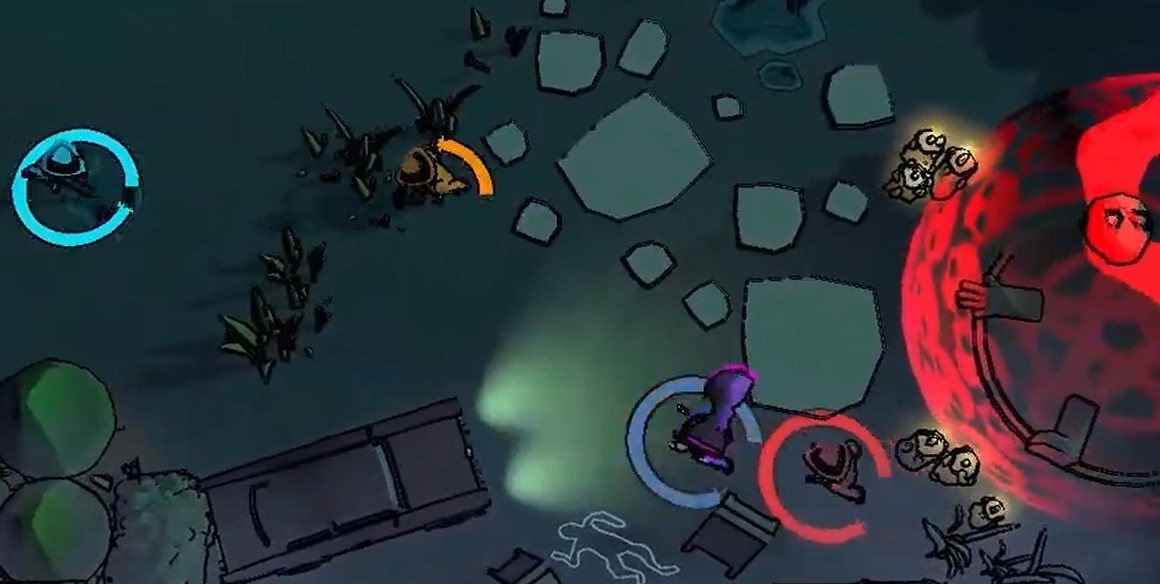
A head, two arms, and two legs are scattered around NecroGangsters' graveyard, but the spawn manager is not shuffling them with a straight face. Every third spawn closes a small deal with the match.
The official game-page screenshot catches three players near a red altar while loose monster parts sit around the arena. The mess looks accidental. Underneath it, new parts arrive in a sequence with three different jobs.
Four players split into two teams and race to assemble a monster at their altar. A complete set needs one head, two arms, and two legs. Deliver the set and the altar builds the supergrunt that wins the round.
Random placement keeps the arena moving, but the win condition is exact. A team does not need any five pieces. It needs five pieces in the right anatomical pattern, which makes the last missing type much more important than another duplicate.
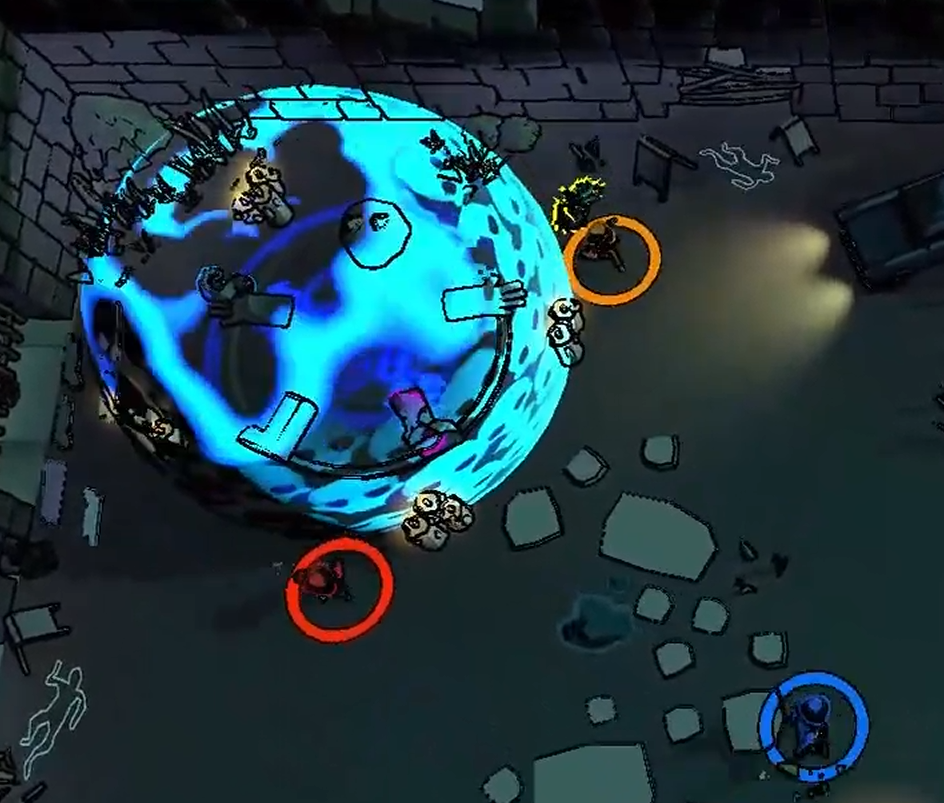
The second spawn repairs the set
Pure randomness can turn that final limb into a queue. Both teams may understand the objective and control the useful ground, yet neither can finish because the needed type refuses to appear. The match has stopped asking for a better decision and started asking the generator to cooperate.
A fixed rotation removes the drought but creates a different problem. Once every head and leg has a known appointment, interception becomes timetable work. NecroGangsters needs pickups to stay surprising without allowing surprise to suspend the objective.
The spawn manager handles body parts in groups of three. The first part is completely random. The second is chosen from a body type still missing from a full set. The third checks rarity: if the cycle has produced no rare or epic part, that slot guarantees a rare one.
The correction reaches farther across cycles. If two cycles pass without an epic part, the third cycle guarantees one. Earlier in a match, an upgrade event can also turn rare parts into epic parts, so the game has another way to introduce stronger buff-bearing pieces without simply flooding the arena with them.
The third spawn watches the rarity clock
Each position repairs a different failure. The first protects surprise. The second protects the collection objective from duplicate-heavy droughts. The third protects the rarity layer from disappearing for too long. Instead of continually adjusting one invisible probability table, the game gives each correction a turn.
That separation matters because a missing limb and a missing epic are not the same shortage. One blocks the round's basic completion condition. The other changes which buffs can enter the contest. Treating both as one luck problem would make it harder to know what the spawn system is supposed to rescue.
Counting the dealer
A three-part deal can become readable in the wrong way. Players who infer the sequence may begin counting pickups, saving their attention for the corrective slot, or timing a fight around the expected rarity check. The system would still be random, but it could feel like a dealer following a visible script.
That may be a useful layer in a competitive party game. Predicting when the arena is likely to receive something important can create another reason to watch the opposing team. It becomes a problem only if counting the dealer matters more than reading the bodies, altars, and players already on screen.
NecroGangsters should appeal to players who want a chaotic race without accepting an endless bad-luck veto. For developers, the sharper idea is not simply to make randomness fairer. Decide which kind of drought each correction is allowed to fix, then ask whether players should notice the correction or only notice that the match kept moving.
Sources
Find NecroGangsters on itch.io
See the current game page, screenshots, and download details.