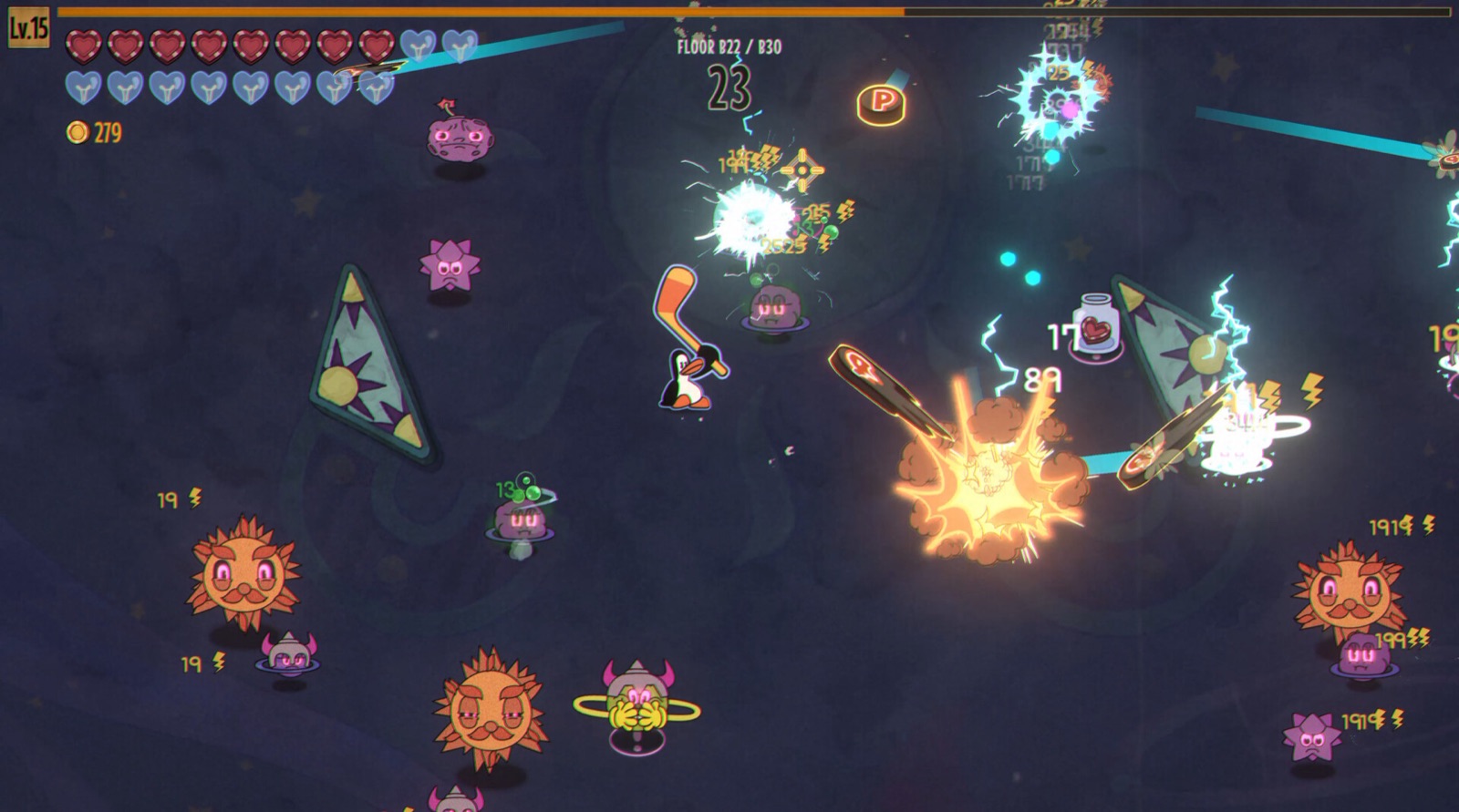
PengPong's developers removed a button they had considered central to the game. The right mouse button used to pull a launched weapon back toward the penguin. In a February demo update, that job became automatic.
Players were not asking for fewer ideas. According to the team's account of the feedback, the inputs made it hard to tell what they were supposed to be doing.
PengPong fills the arena with moving parts. The penguin swings a hockey stick while pucks, guns, headphones, pufferfish, enemies, damage numbers, and incoming attacks cross the screen. The official store page makes momentum and angles the point: direct hits are not the main plan, while bounced objects carry the real damage.
That leaves plenty to decide after recall becomes automatic. The player still has to move, avoid attacks, choose an object, choose an angle, and read what happens after the first collision. The removed action sat beside those decisions, but it was not necessarily improving them.
A core input can still be maintenance
A control can be thematically perfect and still charge too much attention. Manually pulling a weapon back sounds right for a game about sending objects out and getting them into play again. During a crowded wave, however, it asks the player to track one more state while the arena keeps moving.
Recall has to create a choice, not just ask for maintenance. When one response is useful most of the time, repeating that response can make the controls busier without giving the player much more to decide.
The patch notes are unusually candid about this. The team says Pull was regarded as part of PengPong's core fun, yet the most common feedback pointed to too many inputs and an unclear immediate goal. Internal tests with automatic recall worked better than expected, so the team released the change as a public trial and removed items tied to Pull speed.
A June update makes the same priority visible elsewhere. Level-up choices were moved to the end of each wave because a selection screen could interrupt movement and cause the player to lose track of danger. Both changes protect the same thing: an uninterrupted read of a busy arena.
Keep the bounce, clear the attention
Deleting Pull does not flatten the ricochet system. It leaves more attention for the part that can vary from second to second: which object to launch, which line it might take, and what else it could hit before returning.
This is a hard cut for any development team. The patch removes an input, related items, and work that once helped define the pitch. Keeping that work would be easier to justify internally. The public experiment asks a better question: can players notice the decision the mechanic is meant to create?
What disappears with the button
Automatic recall is not free. It decides when recovery begins instead of asking the player. If that timing becomes fixed, PengPong has less room to make recovery itself a deliberate commitment. A return path that is hard to anticipate could also make the weapon feel less like something aimed and more like an effect orbiting the character.
The February announcement keeps that risk open. It calls the change a limited trial and says Pull could return. The current store page stresses bounce angles and momentum, but it does not settle how much control the August release will give the player over recovery. The launch version will have to show whether automatic return stays legible when several weapons and enemy patterns overlap.
PengPong should interest players who want a survivor run to ask for active positioning and aim without turning every weapon state into a separate command. Developers can take a sharper lesson from the experiment: protect the decision that sells the game, even when doing so means deleting the input that once seemed to represent it.
Sources
Find PengPong on Steam
See current screenshots, system requirements, and release details.