
A repair order with a person attached
A broken phone arrives with a customer attached. ReStory asks the player to remove screws, clean parts, find the fault, and put the device back together. The official description also gives the repair a less mechanical possibility: something found inside that phone may force a decision about its owner.
The object can carry part of the story instead of waiting on the bench while dialogue handles everything important.
The player runs an electronics shop in mid-2000s Tokyo. Devices are taken apart piece by piece, cleaned, fitted with replacement components, and reassembled. Spare parts come from a Y2K-style web browser, while orders and shop finances give each repair a business context.
Customers return with their own situations. The official examples include deciding what to do about a disturbing discovery in a former gangster's phone and whether to help a student confess to a crush. Those choices feed a branching story with multiple endings.
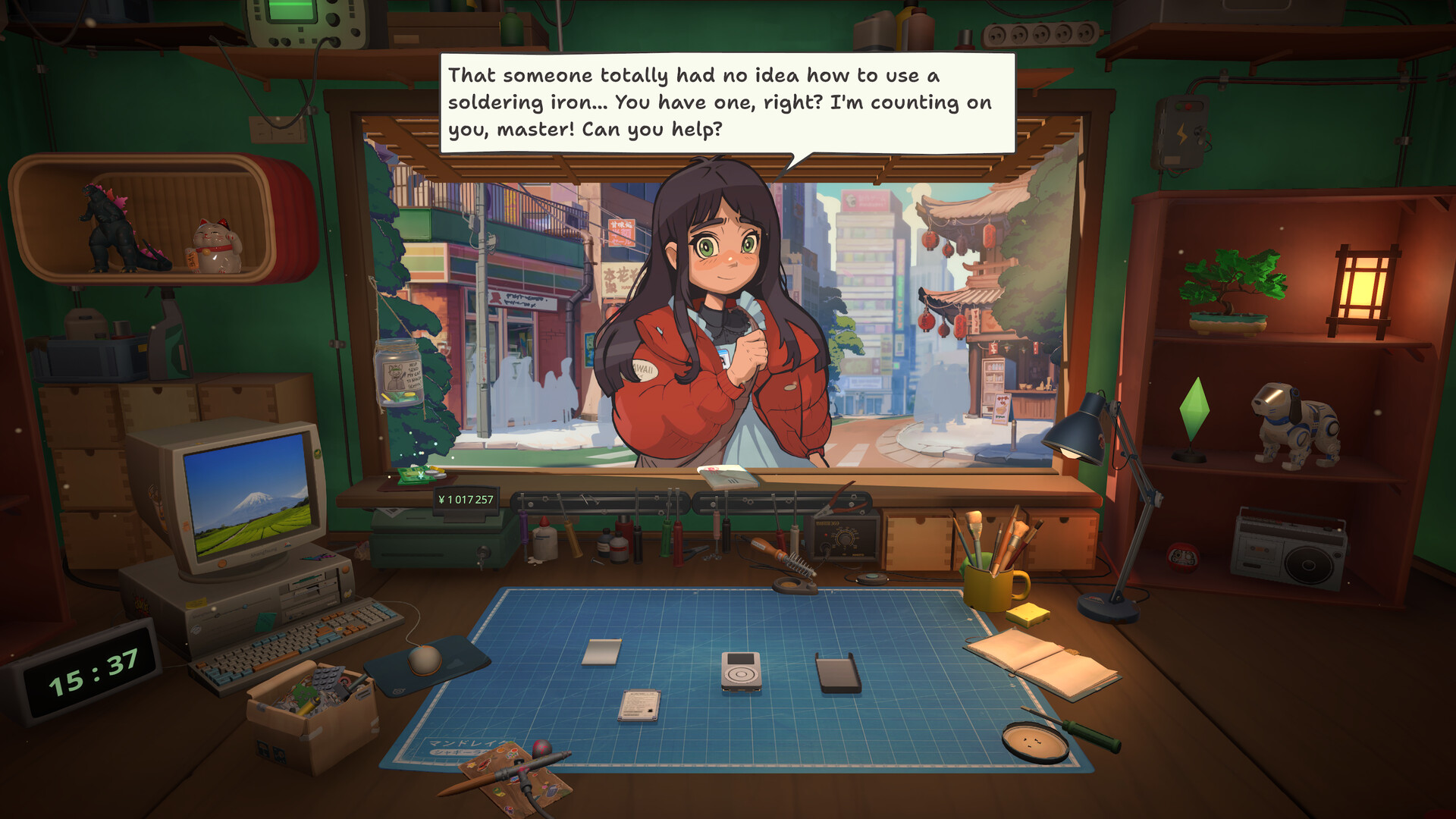
The screwdriver and the dialogue cannot take turns
A workshop loop and a character story can occupy the same game without touching. The player completes a technical task, receives a dialogue scene, then goes back to work. Repetition in one layer does little for the other.
ReStory needs the time spent with an object to change how the customer visit is understood.
The job ticket binds the two layers together. The customer supplies the reason the device matters. Disassembly gives the player a close look at the object and, in some cases, reveals information that changes the social decision. Reassembly then returns that object to the person who brought it in.
The project itself grew from a smaller disassembly activity in Mandragora's I Am Future. Publisher tinyBuild says the response to that activity prompted the team to expand it into a standalone game.
What the device reveals
Repair creates a useful delay. The player has spent time handling a customer's possession before deciding what to say or do, so the choice can arrive with a little more context than a dialogue prompt from a stranger.
The device also gives the story a specific surface. A phone, camera, console, or music player suggests a different history and a different reason someone might want it restored.
When careful work becomes busywork
Detailed work earns its place only while the steps remain worth noticing. Repeated cleaning and reassembly can become a toll before the next conversation. The reverse problem is possible too: a dramatic customer plot can make the careful repair feel like busywork.
The team describes a story-driven game with a systems-driven loop built to last. Device variety, story pacing, and shop economics still have to carry that balance through the full release.
ReStory is for players who want object work to slow a story down and make its small details matter. Players interested only in technical diagnosis may find the customer plots intrusive, while players following the characters may tire of repeated bench work.
Sources
Find ReStory: Chill Electronics Repairs on Steam
See current screenshots, system requirements, and release details.