One stick, two readings
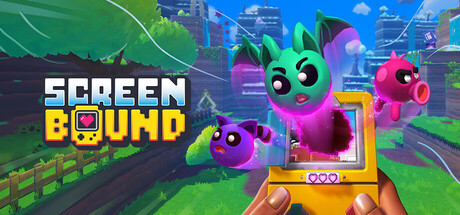
Screenbound puts a handheld game in the player's hands and leaves the surrounding 3D world visible. Pressing a direction moves both versions of the character, yet the two spaces do not agree about depth, platforms, enemies, or what an object can affect.
That disagreement is the useful part. The small screen gives the player another set of rules to read, not a minimap of the room they already understand.
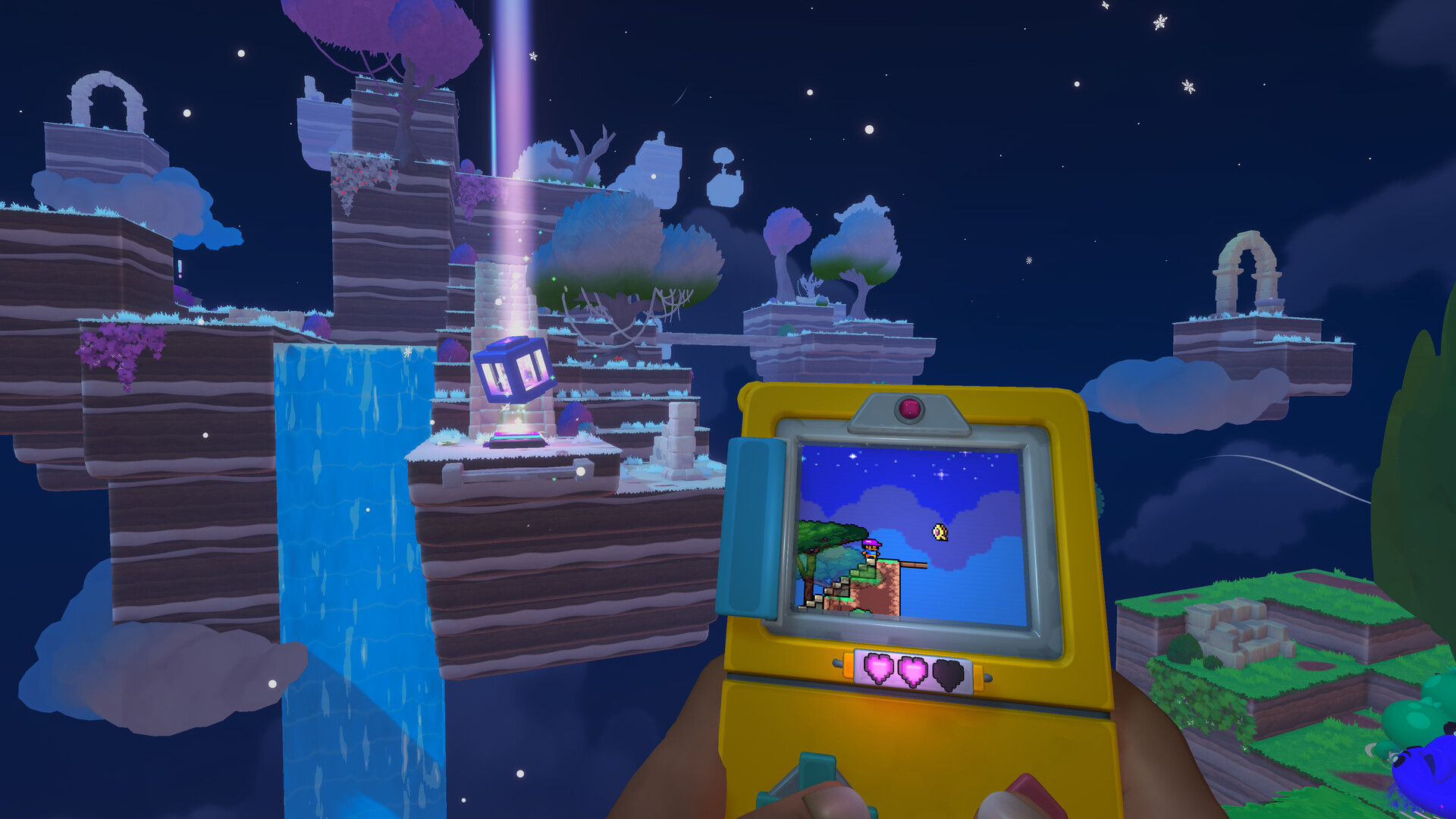
The player moves through a first-person 3D space while controlling a side-view character on the Qboy. Actions mirror across both realities, but some objects, enemies, and platforms exist in only one. A trigger in the 2D game can open a route or change movement in 3D.
Crescent Moon Games founder Josh Presseisen says the team built its level editor around 2D authoring. Blocks and layers drawn there generate their corresponding 3D forms. The two spaces share colour and tone even when one uses pixels and the other uses 3D models.
The small screen has to matter
Two simultaneous views compete for the same pair of eyes. If the handheld only repeats the 3D scene, it has little reason to occupy so much screen space. If it behaves without a stable relationship to the room, the player is left monitoring two unrelated games.
The design needs enough consistency for a player to form a plan and enough disagreement for switching attention to be worthwhile.
Screenbound ties the spaces together through input, then separates them through rules. A jump begins in both worlds, but the available landing places can differ. A balloon held in 2D changes how the player descends through 3D. A door on the handheld can move the player to another part of the surrounding world.
The team's 2D-first editor gives that relationship a production logic. Designers establish the compact rule layout first, then let the 3D structure grow from it instead of aligning two separately built levels by hand.
A puzzle built from disagreement
A stable mismatch can become useful information. A safe platform on the Qboy may explain where a 3D jump can begin, while an obstacle visible only in the room warns that copying the 2D route will fail. The player is checking a relationship rather than chasing two unrelated goals.
Shared colour and tone can help with the first glance. The visual styles differ sharply, so recurring colour can tell the player that two unlike objects belong to the same problem.
The attention bill comes due
The idea asks for a great deal of attention. The handheld occupies part of the 3D view, and the player may need to track threats in both places while moving. A puzzle allows time to compare them; fast platforming or combat may not.
The official demo and footage establish the relationship between the worlds. They do not prove that the controls feel natural, that the foreground device never hides a useful cue, or that later levels keep finding readable variations.
Screenbound is aimed at players who enjoy learning how two rule sets interfere with each other. Players who prefer to read one clean action space at a time may find the Qboy's constant presence tiring.
Sources
Find Screenbound on Steam
See current screenshots, system requirements, and release details.