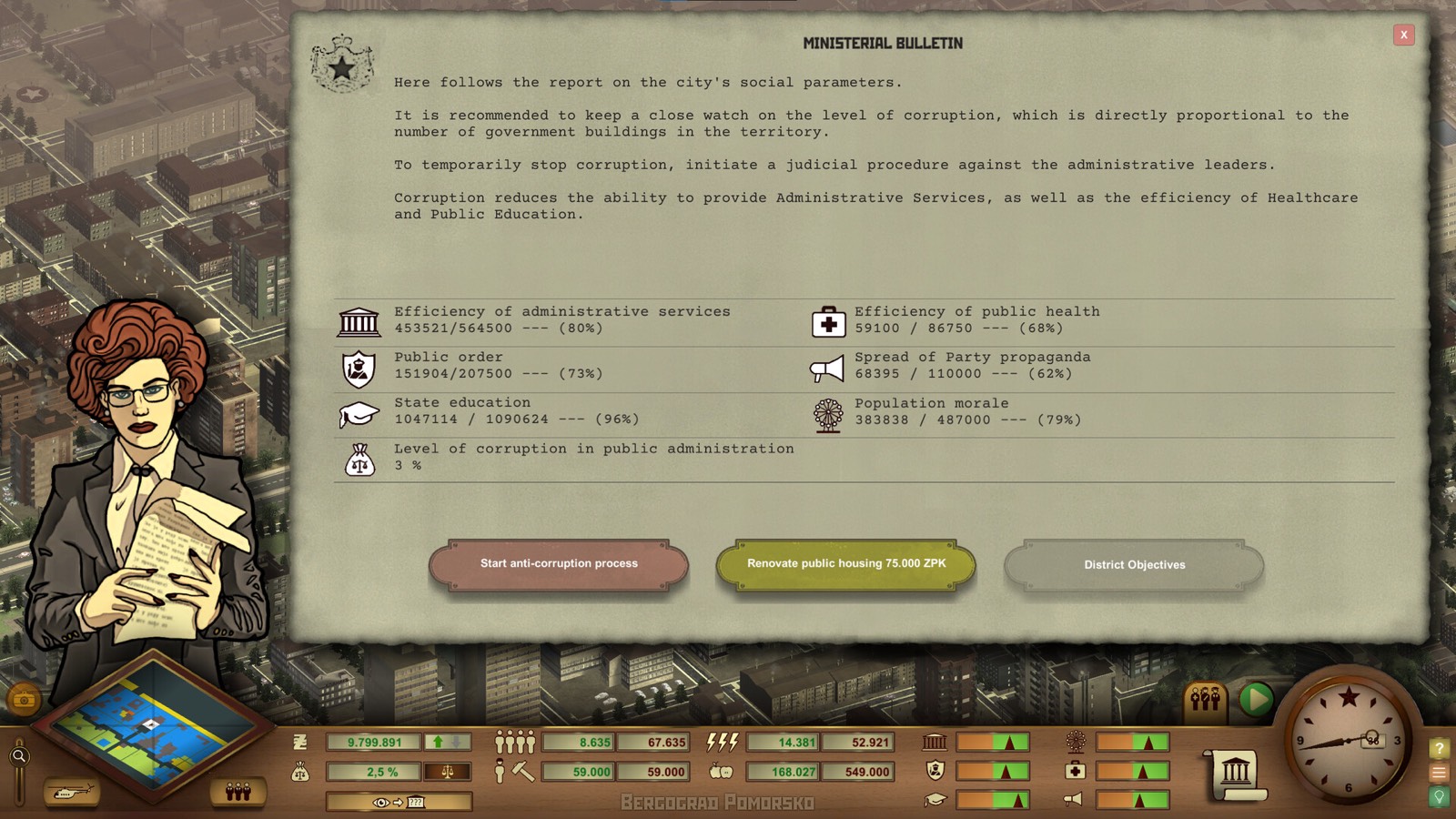
A ministerial bulletin covers most of Socialiskigrad's city view. It lists public services, corruption, and population while three buttons wait at the bottom. One of them says Review Objectives. The mayor may place the buildings, but somebody upstairs is still checking the work.
That chain of command is the game's sharpest idea. Socialiskigrad does not ask the player to build one perfect city forever. It casts each district as an assignment inside a political career, then uses completed objectives to decide when the mayor has earned another post.
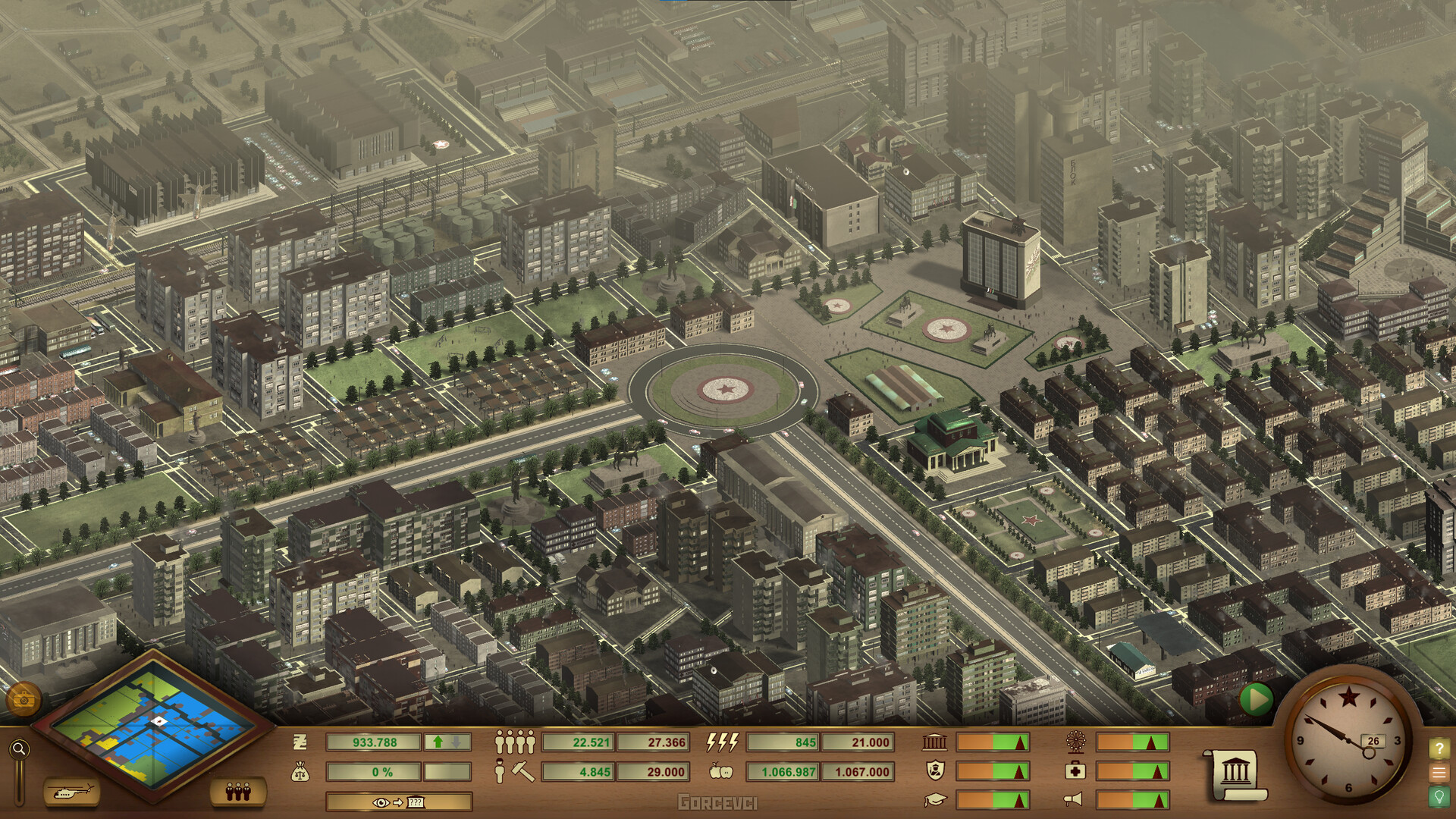
The official screenshots keep the city and its administration on the same screen. Apartment blocks, factories, roads, reservoirs, and ports sit behind a control bar crowded with money, power, food, public safety, healthcare, propaganda, services, leisure, and corruption.
The Steam page describes 14 regions across four biomes. Each district has its own goals, and finishing sector objectives advances the mayor's career while opening new areas and special buildings. The campaign is not separate from the city builder. It tells the player when this particular city has done its job.
City hall gives the sandbox an ending
A blank map can be generous and oddly exhausting. Once the first houses have power and the budget is stable, a sandbox player has to invent the next reason to care. More streets and a larger population may be possible without making the city more interesting.
Objectives solve that hesitation by giving the map a brief. They also threaten the reason people enjoy city builders. If the target says how many factories, homes, and services must exist, planning can collapse into satisfying a form.
Socialiskigrad puts the player inside a bureaucracy instead of above it. The mayor manages a district, answers emergencies and city council requests, introduces taxes, handles strikes, and climbs toward the presidency. A finished objective is both a city result and a line on the mayor's record.
The first open playtest announcement makes that unit of progress unusually clear. With participant consent, the build recorded anonymous playtime and objectives achieved. That does not reveal how players felt about the campaign, but it shows that objective completion is something the developer is watching while the structure is still being tuned.
Promotion can make a district disposable
A district assignment can make restraint meaningful. The player does not need to turn every map into a permanent capital. One region may be remembered for fixing an energy shortage; another may be the place where corruption forced an ugly compromise. Moving on becomes part of the campaign rather than an admission that the sandbox ran out of momentum.
The career also gives unlocks a reason to arrive in stages. A special building can belong to a later posting instead of appearing in a giant opening menu. For a small developer, that structure can teach systems in local combinations and reuse the same economic rules under different regional pressures.
Promotion can make the city disposable. If the player learns that every district ends the moment a checklist fills, long-term consequences matter less than the next unlock. A housing block becomes evidence for a supervisor, not a neighborhood worth repairing after the objective is complete.
The targets therefore need room for authorship. A good assignment names the pressure and lets the player decide what kind of city absorbs it. A weak one names the finished layout. Socialiskigrad's campaign will depend on whether its bureaucracy creates problems to govern or merely paperwork to clear.
What the mayor owes the city
This structure should suit players who like city builders but want a campaign to answer what to do next. Players who prefer one uninterrupted settlement may resent leaving a district after learning its rhythms. The development question is useful beyond this game: can an objective tell the player why a city matters without telling them exactly what the city must become?
Sources
Find Socialiskigrad on Steam
See current screenshots, system requirements, and release details.