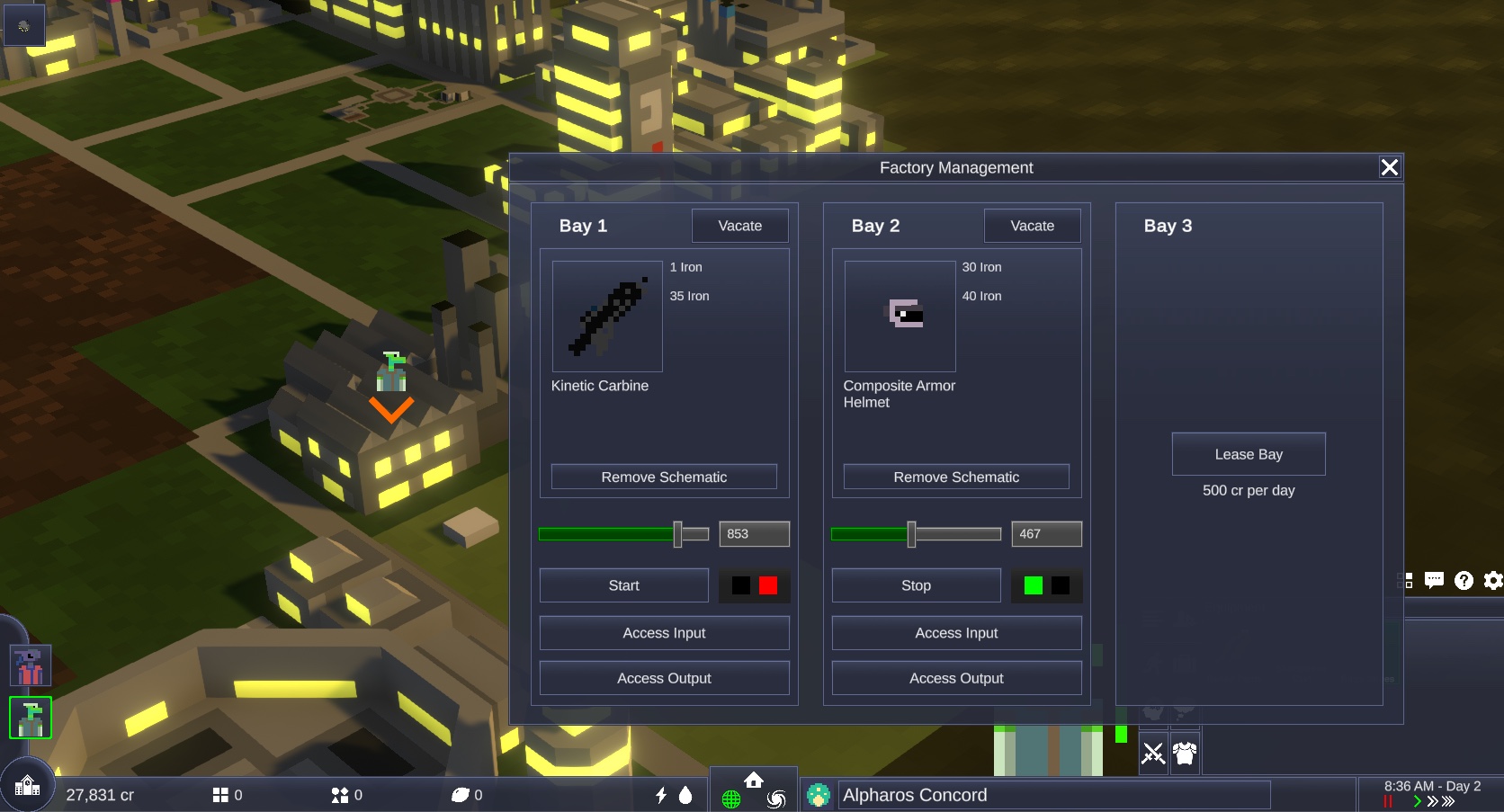
Synthaar's Factory Management panel has a Kinetic Carbine running in Bay 1 and a Composite Armor Helmet in Bay 2. The vacant third bay costs 500 credits per day. Each occupied bay has a button labelled Remove Schematic.
That label is more revealing than the production counters. The factory has not hired the person who designed the carbine. It has received the instructions and can keep building after the inventor walks away.
Synthaar is an in-development space-opera life simulation in which characters can research, craft and trade. Crafting starts with a template, but the template only establishes the kind of object a character knows how to make. The authored version is the schematic.
A schematic records the chosen materials, customization and experimentation applied to an item. The current v0.4.0 crafting milestone lets that plan leave its original workbench on a data disk. Another workbench can install the disk, a buyer can own it or a rented factory bay can use it for production.
The design has to survive the handoff
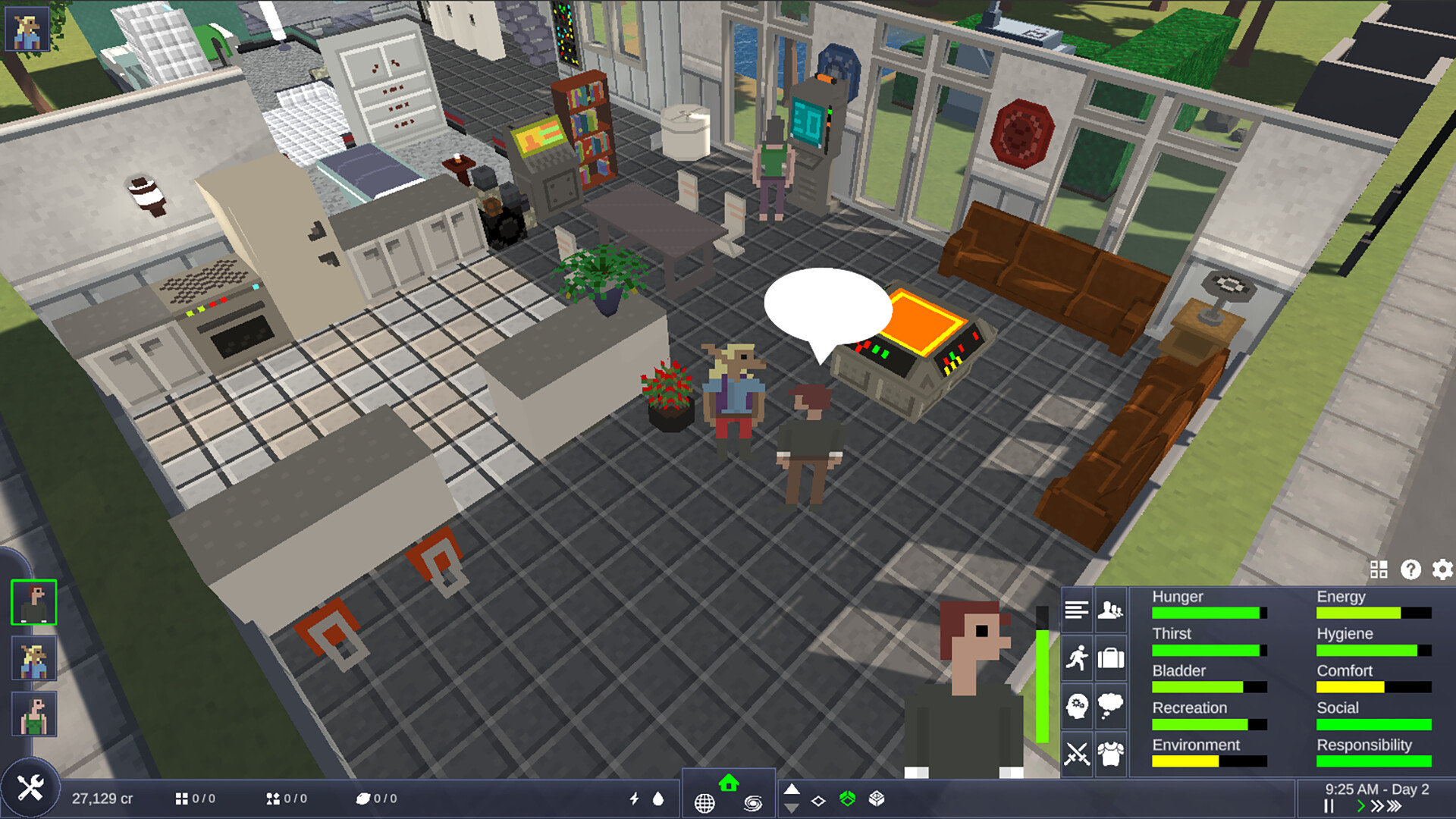
Experimentation gives a weapon a point of view. The official interface divides a carbine among damage, speed and condition, and asks the designer where to push it. If those decisions disappear when a second character starts crafting, scale turns a designed object back into a generic recipe.
Keeping every good schematic inside its inventor's workbench causes the opposite problem. The plan remains distinctive, but the person who made it also becomes the production bottleneck. A life simulation about trade needs expertise to move without pretending expertise never mattered.
The data disk separates designing from building. One character can research the template, choose materials, accept the experimentation risk and then copy the resulting schematic. Other characters can install that copy and work at separate benches without recreating the design step by step.
Factories extend the same handoff. A city factory offers as many as three bays for a daily fee. The player supplies a schematic and resources, and the bay packages completed items into crates over time. The carbine stays on the production line. Its repeatable description is what crossed the boundary.
The factory receives a plan, not a person
This gives crafting knowledge somewhere to live in the economy. A weapon can be used, but its schematic can be copied, installed, sold and made productive by several workers. The record preserves why one version differs from another instead of asking each crafter to rediscover the same material and attribute choices.
The factory screenshot makes that separation legible. The carbine and helmet occupy different bays as plans, not as employees. A third empty bay displays its rent before it displays an item, making production capacity another cost the design has to earn.
Consistency gives up the exceptional result
Automation does not preserve every advantage of hand production. The developer says a factory always produces the same quality. A character at a workbench can finish above that level or below it. Factory output buys predictability by closing off both the bad roll and the exceptional one.
The schematic has already paid for uncertainty before it reaches the factory. Experimentation can lose resources, and experimenting on a dangerous object such as a firearm can start a fire. The search for a strong design can therefore include expensive failures before it reaches a safe, fixed production line.
That tension is the part worth watching. If copying a proven disk is always the correct answer, invention becomes a brief tax before automation. If workbench quality and experimentation keep offering meaningful reasons to revise a design, the disk can carry expertise without freezing the whole crafting game.
Players who like economic games where knowledge can be owned, rather than merely unlocked, have a reason to follow Synthaar's crafting system. For developers, the sharper test is whether a copied plan changes who can make an item while keeping the original design decisions traceable and worth preserving.
Sources
Find Synthaar on Steam
See current screenshots, system requirements, and release details.