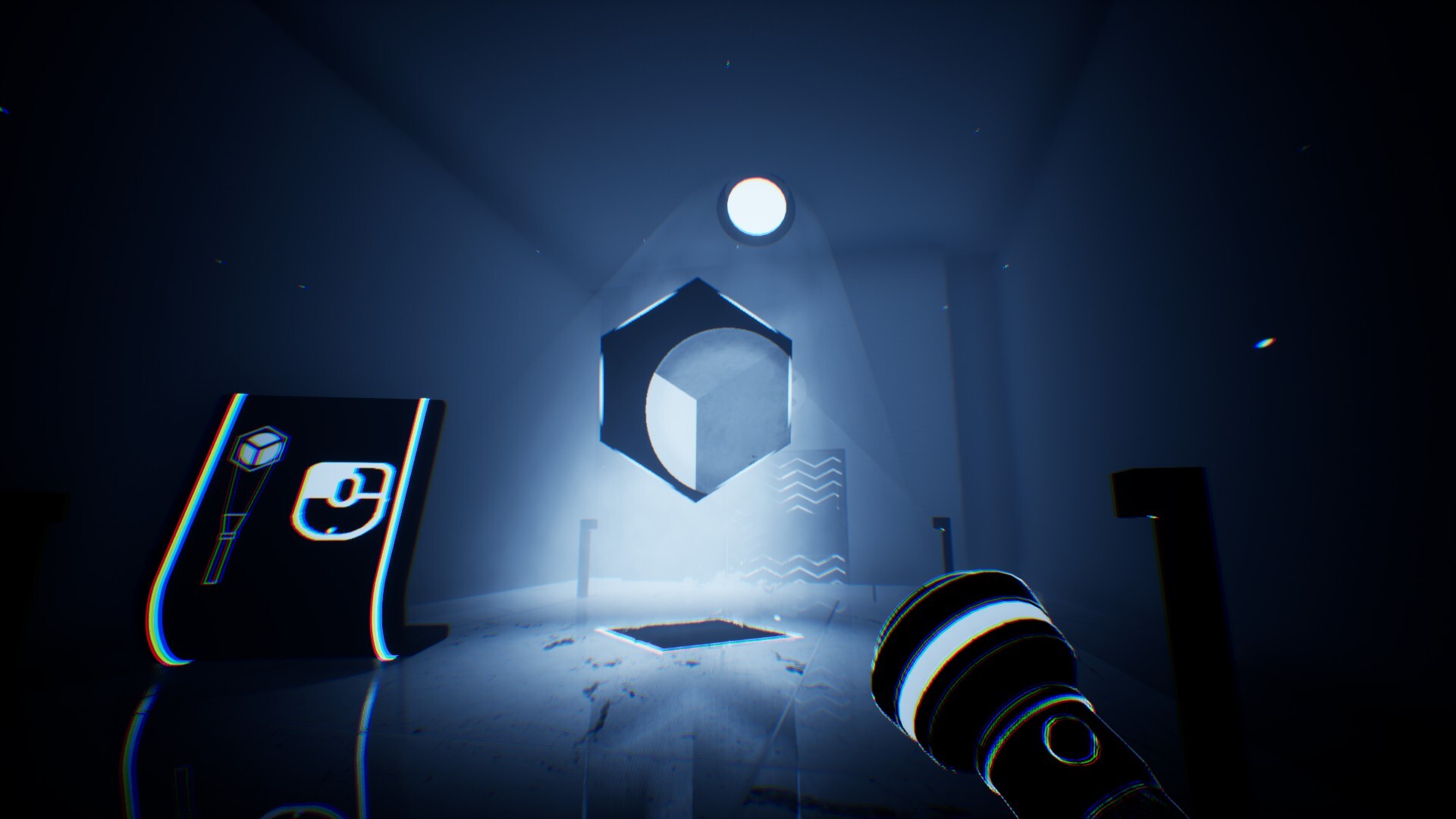
The flashlight gives things weight
A flashlight usually tells the player what is already in a room. THANKS, LIGHT. lets the beam decide whether part of that room has mass.
Shine on a silhouette and it can become a platform, pillar, or movable object. Absorb the light and the same form flattens again. Looking at the puzzle and changing it become the same action.
The official screenshots and videos show stark first-person chambers, a handheld light, and geometric forms that move between flat outlines and solid objects. The official pages say illuminated forms gain volume, collision, weight, and gravity. Removing light can stop a rolling ball or turn a wall into a passable surface.
The rule expands through mirrors, lenses, and merging. Mirrors duplicate, lenses resize, and merging combines forms. The studio site also demonstrates that one object can produce different silhouettes when viewed from different angles.
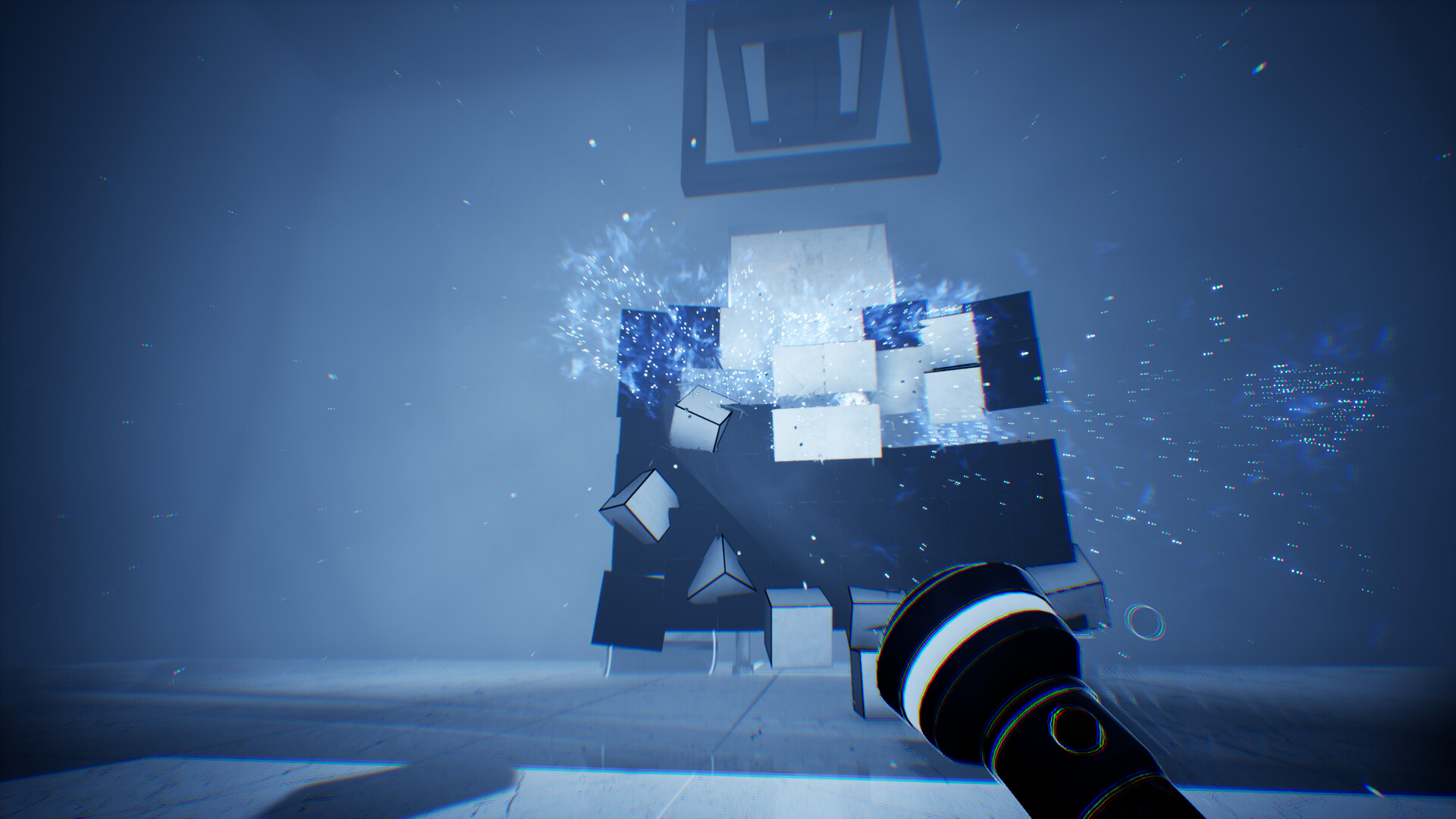
One beam has to teach two states
A spatial puzzle has to tell the player what can change. Make every useful surface glow and the room begins to label its own solution. Hide the distinction too well and exploration becomes a search for the one object the designer marked as interactive.
THANKS, LIGHT. also needs the player to understand a change of state. The beam reveals a shape and changes what that shape can do. It may begin to support, block, fall, or move.
Illumination acts as both pointer and switch. The beam identifies a target while giving that target physical properties. Absorption reverses the state, so the player can remove an obstacle with the same visual language used to create a platform.
The publisher says the game avoids lengthy tutorials and expects observation from different angles to teach the rule. The later mechanics appear to build on that relationship instead of replacing the flashlight with an unrelated set of commands.
The beam draws a visible line between action and consequence. The player can see which object received light, then watch its outline become something that belongs to the room. That direct cause may make an unusual physics rule easier to test without opening a menu.
Later mechanics reuse the same question. A mirror changes where illumination arrives. A lens changes the scale of the result. Merging changes which form the light can produce. In each case, the player still asks what will become physical when the beam reaches it.
When atmosphere muddies the rule
The visual language has to carry two messages at once. Light establishes the mood of the chamber, but it also reports whether an object has physics. If a solid form and a decorative highlight look too similar, a missed jump may feel like bad feedback instead of a wrong hypothesis.
Every extension asks the player to remember more about the original switch. Once duplication, resizing, merging, and perspective affect the result, a clean light-on, physics-on rule could become a list of conditions. The current footage does not reveal how clearly those combinations read in motion or how often a solution depends on exact positioning.
THANKS, LIGHT. is likely to suit players who enjoy learning a puzzle rule by manipulating the room rather than reading a long prompt. Players who prefer explicit state icons, or who find dark high-contrast first-person spaces difficult to parse, should watch the available footage closely before deciding whether the visual rule reads clearly enough for them.
Sources
Find THANKS, LIGHT. on Steam
See current screenshots, system requirements, and release details.