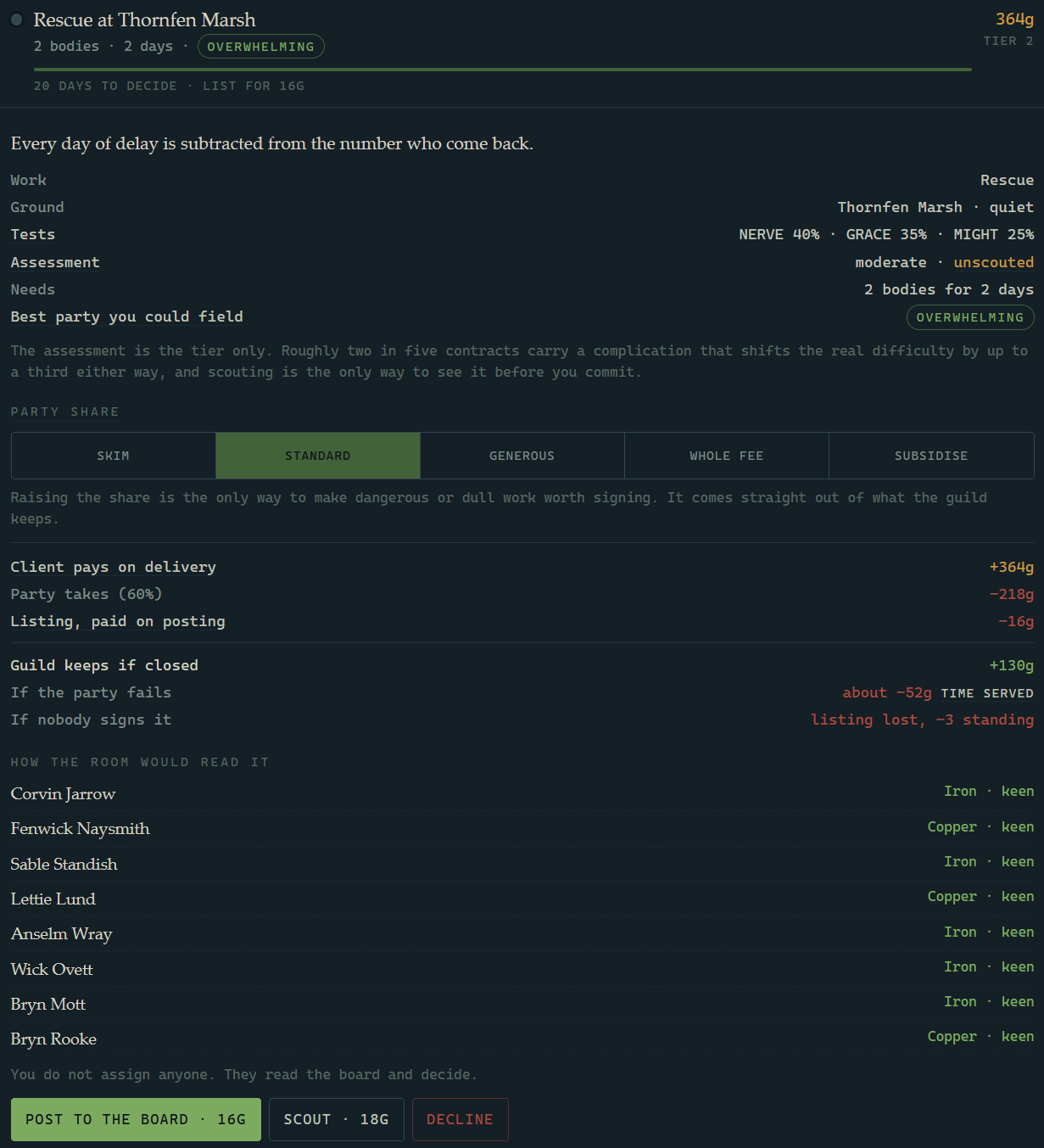
The rescue at Thornfen Marsh needs two bodies for two days. The client offers 364 gold. The job is unscouted and labelled overwhelming. Farther down the official Board screen, eight adventurers are listed under How the room would read it. Every one is keen.
The player can change the party share, pay to scout, post the contract or decline it. Selecting two names is not one of the options. A sentence below the roster explains why: You do not assign anyone. They read the board and decide.
The Ledger is a released browser management game about running an adventurers' guild from behind a desk. The guild master never sees the fight. Contracts arrive at the Board, parties return at Dusk and the result comes back as a report attached to its cost and consequences.
Before a contract leaves the desk, the player controls its terms. Listing takes money and a board slot. The party share can range from skim to a subsidy that pays more than the client fee. Scouting costs more money in exchange for a better account of the danger.
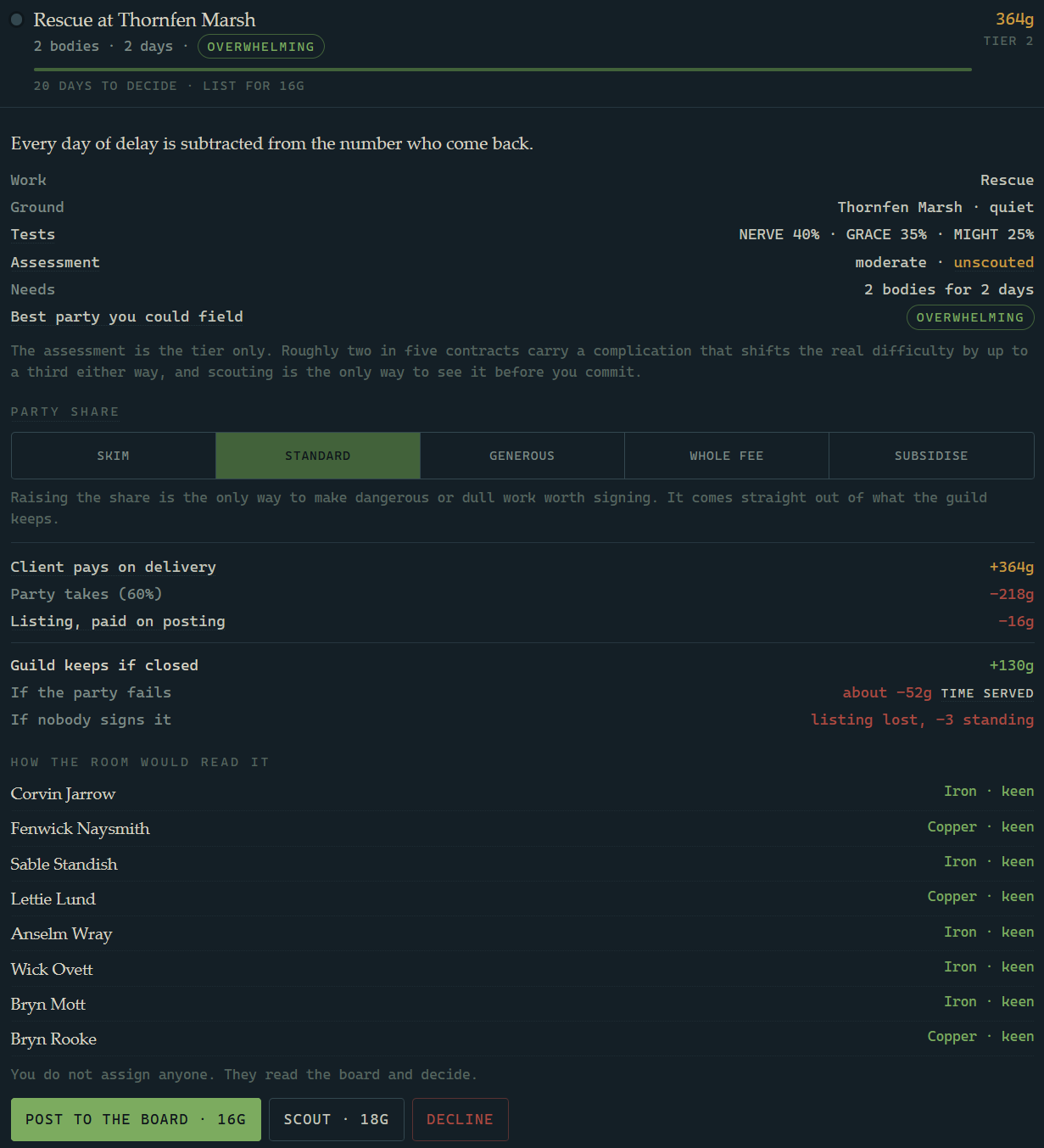
The missing button is the point
An Assign button would make every adventurer obedient. Rank, caution and resentment could still modify success, but none of them would decide whether a person accepts the work. The roster would be a set of units waiting for the guild master to move them.
Removing that button creates a different problem. A refusal with no explanation looks arbitrary, especially when the player has already paid to list the job. The game needs adventurers to own the final yes without making the guild master guess which invisible rule produced a no.
The developer's appeal model starts with an asking price: an adventurer's wage for the contract's duration, increased by how dangerous the work appears. The offered share is compared with that price. Greed, ego, caution, morale and grudges can change the reading, so two people do not have to value the same posting alike.
They are not allowed to see through uncertainty that the player has not resolved. Some contracts hide a complication that changes the real difficulty. Adventurers judge the posted assessment rather than the hidden truth, which means scouting changes the information used by both sides instead of simply adding a player-only bonus.
A refusal prints its own reason
The interest list is what keeps this arrangement from feeling like a coin toss. Its labels include keen, considering, wants more pay, too dangerous for the pay, beneath them and aggrieved. According to the development log, those labels come from the same appeal function that decides whether each person signs.
A refusal therefore points back to a condition the player set or failed to investigate. Raise the share and the guild keeps less. Scout and the listing costs more before anyone accepts. Decline and the unanswered request continues toward expiry. The guild master still makes the offer, but the roster is allowed to answer it.
A person can become a price threshold
The clean feedback can make a person too readable. If wants more pay is the dominant objection and one richer share reliably flips it to keen, the roster's independence becomes another purchasing interface. Names and grudges decorate a threshold the player solves with arithmetic.
More opacity would not automatically create richer characters. It could turn an expensive listing into a refusal the player cannot diagnose. The Ledger chooses accountability and accepts that its personality model will be visible through the numbers.
The harder test comes after the reason is known. A convincing autonomous roster should leave the guild master with more than one credible response: improve the offer, learn more about the danger, prepare different people or let the job go.
Players who prefer management as setting conditions rather than moving units will find the guild master's authority deliberately narrow. For a small developer, the useful question is whether an agent's no creates another decision or merely asks the player to drag the pay slider one step farther.
Sources
Find The Ledger on itch.io
See the current game page, screenshots, and download details.