A customer who knows exactly what they want does not create much of a puzzle. Wax Heads fills Repeater Records with indecisive people, then asks the player to work out what their half-formed requests mean.
The answer is not contained in one dialogue box. The player searches records, local zines, and social posts before carrying an album back to the counter. The shop is the evidence board.
Repeater Records holds more than 80 hand-drawn albums. Each belongs to an invented artist with a history and fanbase. Customers ask for help, and the player can browse sleeves and records, read about bands, scroll social media, and consult local music zines before making a recommendation.
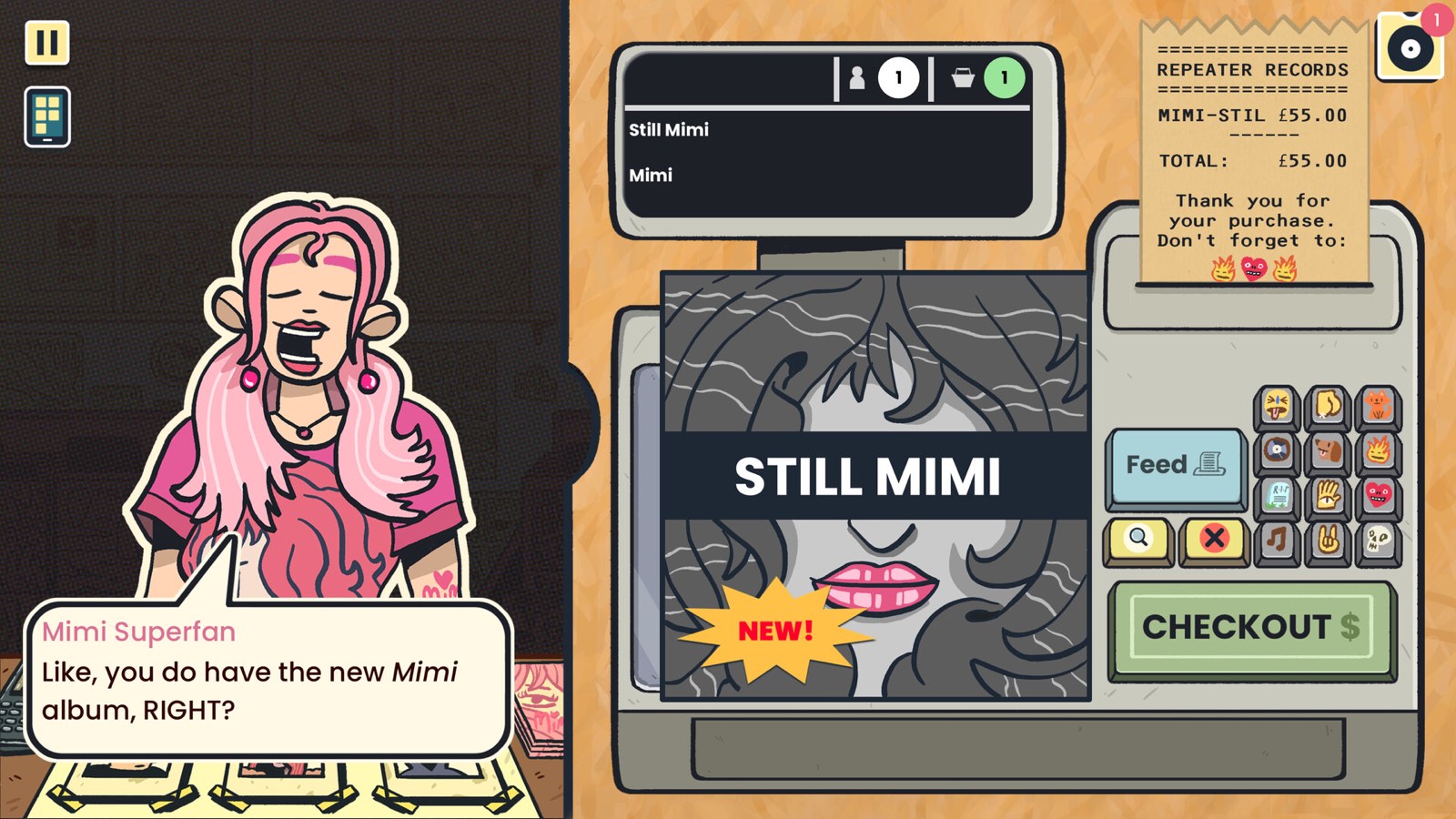
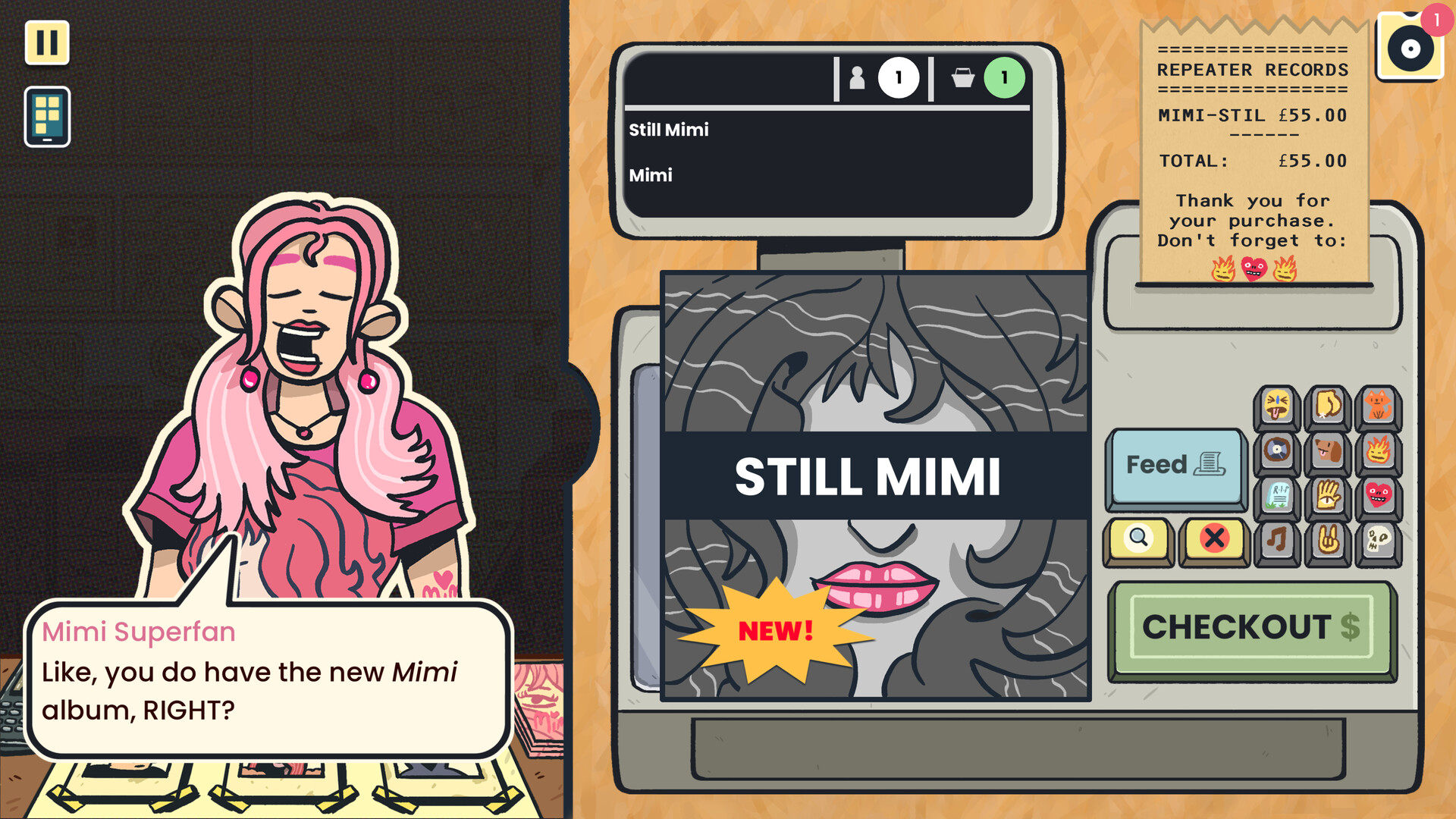
An official screenshot places the customer beside the checkout, with the selected album between them. That composition keeps the request and the proposed answer visible at the same time. Record inspection and the fictional bands behind the stock supply more clues.
Taste cannot become a genre lookup
Recommendation is difficult to turn into a fair puzzle. Music taste can be inconsistent, and two records may suit the same sentence for different reasons. Reduce the task to matching a genre word and the customer stops mattering. Hide the deciding clue and a wrong answer feels arbitrary.
Wax Heads needs enough structure for the player to reason toward an album while preserving the sense that they are reading a person, not sorting inventory.
Patattie Games built the catalogue as a fictional music scene rather than a row of abstract answers. Album art, band history, fan culture, zines, and social posts give each record several ways to connect with a request. The player gathers those connections before choosing at the till.
The same information can do two jobs. It narrows the current recommendation and teaches the player how the shop's artists relate to one another. A fact discovered for one customer may make another part of the catalogue easier to read later.
Learning the shop before judging the customer
This structure can make browsing feel like progress. Opening a sleeve is useful even when it is not the final answer, because it adds another artist, feud, era, or audience to the player's mental map of the store.
It also gives a two-person team a compact way to join story and puzzle production. A fictional band can supply a song, an album cover, a piece of shop history, and a clue without requiring a new mechanical system for each appearance.
Fair clue or hidden rubric?
The design has to decide how subjective a recommendation is allowed to remain. If every request has one plainly signposted match, the player is retrieving a fact rather than making a judgment. If several albums fit but the game accepts only one, the customer may seem less believable at the moment the puzzle resolves.
If several albums seem plausible, the game needs to explain why one answer works and another does not. Later searches also need to produce new deductions instead of familiar lookups.
Wax Heads is likely to suit players who enjoy reading fictional documents and building a picture from small, scattered details. Players who want a management game driven by prices, stock levels, and expansion may find that the shop is more interested in conversation and deduction than retail strategy.
Sources
Find Wax Heads on Steam
See current screenshots, system requirements, and release details.