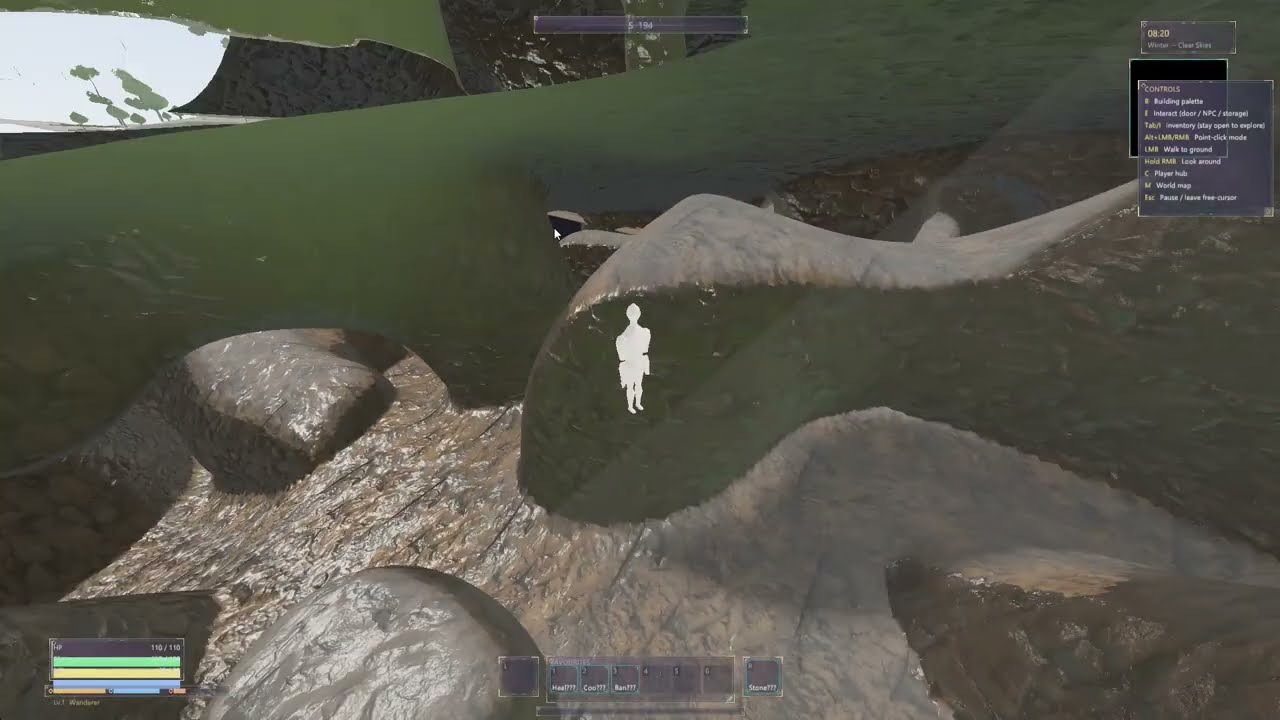
A white character stands under a shelf of green earth in the official August gameplay thumbnail. Grey rock folds below. More ground hangs overhead. That ceiling is the point.
Where Giants Rust used to generate its world as a heightmap. It could layer dirt, grass, stone and snow across a continuous landscape, but the developer describes that landscape as a skin stretched over nothing. A mountain had a top and no inside.
The current rewrite replaces that skin with volumetric block terrain. Solid rock sits below the surface. Overhangs can project above the player, a seabed can continue underwater and caves can cut through the same landmass as the coast and inland mountains.
The surface still carries material rules. Dirt can be tilled, grass grows on dirt rather than rock and moss sits on stone. Player digging and placement are recorded separately from the generated world so those changes can be saved.
The old mountains ended at their skin
A heightmap is good at answering one question: how high is the ground here? That produces hills and valleys cheaply, but it cannot describe two layers at the same horizontal position. There is no ceiling above a cave floor because the data only knows one height.
That limit matters once a survival game gives the ground jobs beyond scenery. A shovel needs something to remove. A tunnel needs material around empty space. Returning to a saved excavation only matters if the hole belongs to the world rather than a temporary visual effect.
Digging needed more than a shovel
Blocks let the same position contain air, soil or rock at different heights. Digging can therefore remove actual volume instead of lowering one exposed surface, while caves and overhangs can exist without hiding a second map beneath the first.
The rewrite also had to protect the rest of the game from the change. The developer reports that vegetation, settlements, NPCs, pathfinding, enemies, resource nodes and the map all read the new terrain without being rewritten. For the player, those systems can keep asking where the ground is even though the answer now includes an underground.
This gives excavation a spatial consequence. A removed block can open a route, expose a wall or leave a ceiling above the player. The result is not just a lower patch of ground. It is a new piece of navigable space that can survive a save.
Material layers keep that freedom from becoming anonymous. Tilled dirt, grass and moss tell the player that the surface still has a type even though the mountain is now built as a volume.
The cave generator leaves almost no mountain
The current caves show how quickly this freedom can eat its own subject. The developer says the carving is so aggressive that almost no solid rock remains underground. The system is scheduled for a rewrite, not a smaller numerical adjustment.
That is the harder design problem behind a diggable mountain. Every cave and player-made hole subtracts material, but the rock left behind is what gives either one a shape. Too little removal and the underground is decorative. Too much, and the mountain becomes a loose shell around empty space.
Players who want survival terrain to behave like material rather than painted scenery have a reason to follow this rewrite. For developers, the useful test is not whether a shovel can delete a block. It is whether the hole creates a route, room, farm edge or shelter that is still useful after the player returns.
Sources
Find Where Giants Rust on itch.io
See the current game page, screenshots, and download details.