

COCOON
COCOON Makes You Carry Entire Worlds. How Does Sound Help Its Puzzles Make Sense?
Synthetic textures give its nested worlds a physical presence, while selective musical cues can help players trust an assembled solution before the final action. Repeated carrying can still become routine.
 IrisArt & Visual LanguageDesign notebook · 9 min
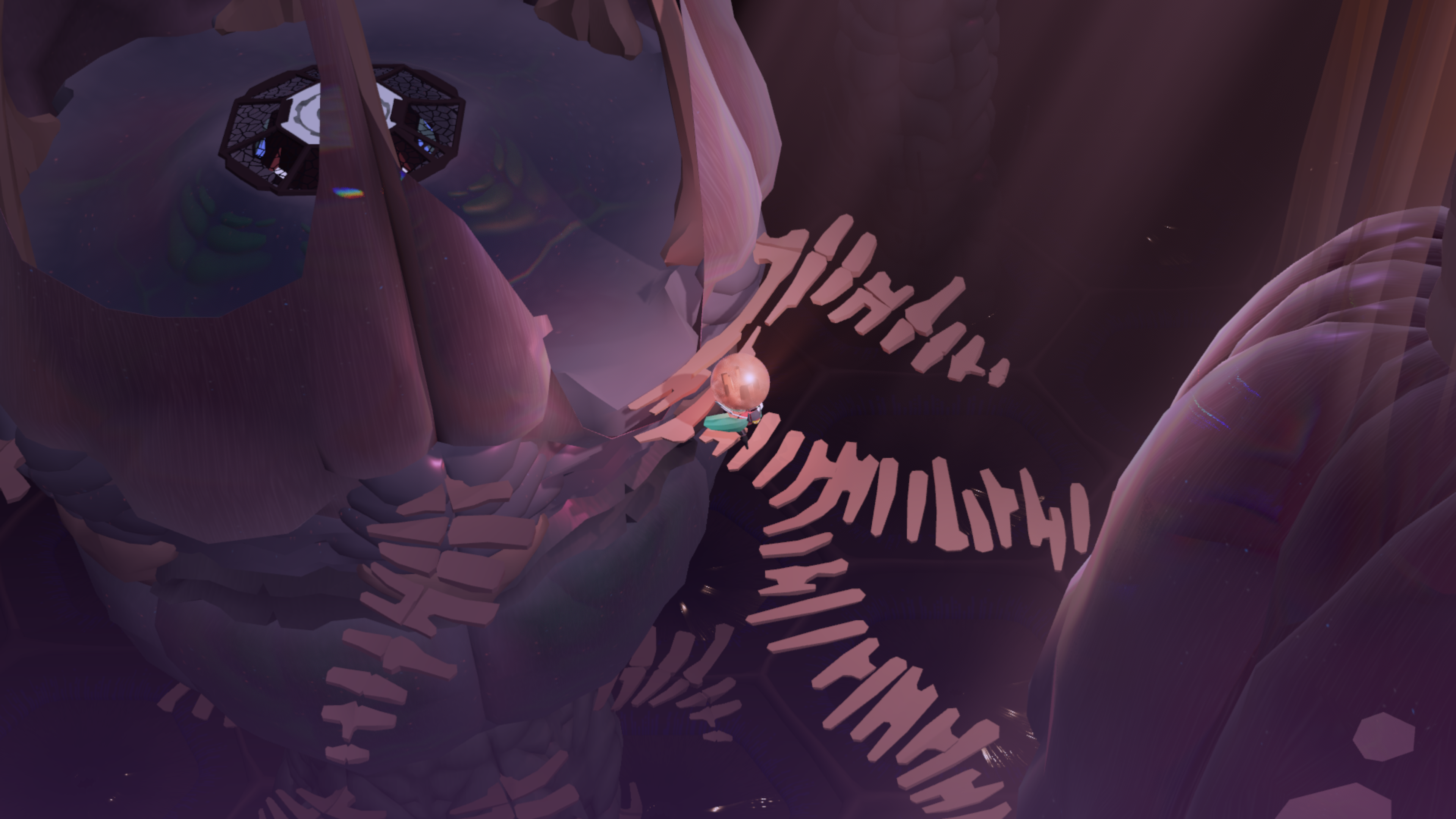
Official 2022 promotional screenshot. An orb-bearing figure stands among purple, rib-like forms.
COCOON © Geometric Interactive. Source: Annapurna Interactive / Geometric Interactive official press assets. Source ↗
The most delightfully disgusting detail in COCOON's production is a checkbox in an audio-restoration plugin.
Sound designer Julian Lentz made slimy, organic friction from white noise, a vocoder, and iZotope RX De-Crackle. The last of those usually helps remove unwanted crackling. Lentz selected its “Output crackle only” option, keeping the little artifacts that the software was designed to isolate. Those brief sounds could suggest something wet rubbing against something else. In his guest slides for Jakob Schmid's GDC talk, changes to the vocoder's controls alter the apparent hardness of a surface or suggest a cocoon opening. No bowl of suspicious goo required. Schmid and Lentz's GDC slides, pages 72–74
I love that choice because it gets at something more interesting than technical ingenuity. COCOON asks us to accept worlds that can be picked up, carried, and placed inside other worlds. That is an awfully abstract proposition. Giving those places a convincing squelch provides a wonderfully unreasonable form of reassurance: the universe may be impossible, but apparently it has a surface.
A world with something under its skin
Geometric Interactive's puzzle adventure follows a small winged creature through landscapes housed in portable orbs. An orb can be a destination, a tool, or luggage containing another destination. Its power also matters outside its own world. The orange orb reveals otherwise invisible routes; the green one changes the state of particular platforms. Carrying only one object at a time turns those relationships into practical problems. Game Informer's review
For example, placing one orb inside another world's landscape lets the creature transport both while still carrying a single object. The catch is retrieval: there must be somewhere to enter that carried world and collect its contents. Choosing what to pack therefore also means planning how to get it back out. I like how this brings the scale of the premise down to a graspable decision. An entire reality becomes luggage, and the important question is whether you can unpack it where you need it. GameLuster's review
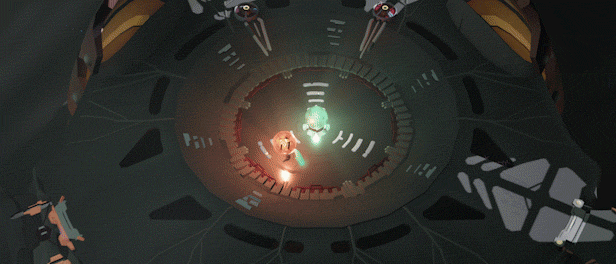
The character carries an orange orb into the green world, then walks away with it.
COCOON © Geometric Interactive. Official press GIF supplied by Annapurna Interactive / Geometric Interactive.
Official promotional footage; capture date and build unspecified. This silent animation illustrates carrying and world entry.
That premise could easily produce a diagram that happens to move. Artist Erwin Kho wanted places with recognizable environmental character. His orange world's bridge-making ability suggested cliffs and ravines; green became lush and relatively flat to distinguish it. The purple world's cloning idea suggested mirrored, repeated organic forms. Appearance helps hold the rules in your head. SUPERJUMP's interview
The more productive word for this art direction is “specific.” Minimalist can make it sound as though the team simply removed enough things. Kho's vocabulary includes sea-urchin shells, monumental architecture, and the contrast between rigid edges and softer forms. Rendering programmer Mikkel Svendsen supplied the lighting and atmosphere that helped bring those shapes together. The result gives the mechanical and biological parts of this universe a shared family resemblance. Push Square's developer interview
That resemblance also keeps the world pleasantly suspect. A machine that behaves a little like an animal raises a question before any story begins. Is this equipment? Is something being kept alive? COCOON can establish the feeling of a system without explaining what that system is for.
The pleasure of moving something
Its most important design lesson may be that a puzzle game can afford an obvious interaction.
Jeppe Carlsen told Game Developer that he had to loosen his own attachment to tricking the player. Some pipe puzzles earn their place because following an object through the landscape is satisfying. The team also staged conceptual discoveries in small increments and worked on making failed ideas unmistakably fail. Getting an answer wrong should not leave someone wondering whether a sixth attempt will suddenly work. Game Developer's interview
The tactile treatment makes that generosity viable. Jon Bailes opens his PC Gamer review with a pull-switch whose metallic ball remains attached by an elastic, gum-like connection; operating it makes nearby flesh ripple. It is a simple task made worth attending to. My reading is that these moments establish a bodily vocabulary for the stranger operations ahead. Before a world becomes something to rearrange, the game has made moving things interesting. PC Gamer's review
Lentz's account of the audio makes the same principle explicit. Synthetic sounds needed fluctuations and imperfections to suggest natural materials. He wanted the environments to have texture; he describes their uneasy, not-quite-authentic quality as a result of that work. Schmid's larger constraint was to synthesize the sound material throughout the game. The sound designers pushed that rule into rain, footsteps, creatures, and machinery. A Sound Effect's interview
That is why the slime matters. It gives the geometry resistance. Even an interaction whose answer is obvious can have a texture worth noticing.
A little confidence before the answer
The audio also takes responsibility for something that pictures cannot easily show: whether the arrangement of several separate worlds is making sense.
Carlsen describes musical motifs that acknowledge a newly understood relationship between worlds. They are selective. Repeating an old solution need not earn the same flourish. The cue can arrive while the player is still transporting an orb containing the solution, offering confidence before the final action proves it. DayOne's developer interview
Schmid explains the implementation to Austin Wintory: particular configurations trigger an event, relevant ambient music recedes, and a small rewarding phrase plays. It is an authored response to a state the designers recognize, rather than a system somehow reading the player's thoughts. The Game Maker's Notebook, 50:15–58:08
I find that a more affecting use of game music than another victory fanfare. In the situation Carlsen describes, the cue offers a reason to keep carrying the assembled solution before the final action confirms it. Here, music meets the vulnerable interval between having an idea and trusting it enough to follow through. For a game so full of alien machinery, that is a remarkably considerate little gesture.
The distinction between kinds of music is important, too. COCOON combines prepared musical moments with ambient instruments that generate sound during play. The sound effects and big-moment musical vignettes were pre-rendered; the ambient music uses real-time synthesis. The different systems let decisive moments have shape while slower stretches can remain changeable. A Sound Effect's interview, Schmid's GDC slides, page 16
When fluency becomes routine
This much care does not erase the cost of the design.
Kyle Hilliard's Game Informer review identifies passages where understanding a solution leaves a procedure to carry out. GameLuster's Nairon Santos de Morais is sharper about the repeated trips to move objects. My reservation begins at that particular point: when you have worked out where the orbs belong, but still have to collect and deliver them one by one. The carrying limit that made packing interesting can then prolong a settled decision. I value the pipe puzzles' invitation to notice the landscape; repeated retrievals need to earn that attention again. A satisfying sound cannot make every return journey a discovery. Game Informer, GameLuster
Nor do wordless play and controls built around movement plus one action button make a game equally approachable for everybody. Nintendo Life notes the demands of reaction-based boss encounters; Windows Central's launch-era assessment criticizes the limited accessibility options. The elegance of the main path should not obscure the people who may need another way through it. Those are assessments of the reviewed releases, rather than a fresh test of today's builds. Nintendo Life, Windows Central
Its narrative reserve is another real trade-off. Siliconera's Leigh Price finds too little grounding to confidently form a theory. The creators themselves acknowledge that their explanations of the game might differ. I would rather preserve that uncertainty than promote a clever interpretation into a definitive answer. Siliconera, GameSpot's developer interview
To Games It May Concern's long-form essay treats that desire for an outside perspective as part of COCOON's appeal: each larger frame promises an answer, yet can itself become another frame. That is an interpretation I find useful without needing it to settle the story. Mastering a system and knowing its ultimate purpose are different achievements. To Games It May Concern, 10:06–14:00
What interests me most is the way COCOON makes the first achievement feel physical. Its logic comes with surfaces, weight, and carefully timed encouragement. A world is small enough to carry and strange enough to resist explanation. Somewhere in the machinery, a cleanup tool is dutifully saving the wrong part of the sound, and the impossible thing gets a little more convincing.
Sources & research
Sources include developer interviews, criticism, a primary technical slide deck and commentary transcripts from two long-form videos.
- Schmid and Lentz's GDC slides, pages 72–74 ↗
- Game Informer's review ↗
- GameLuster's review ↗
- SUPERJUMP's interview ↗
- Push Square's developer interview ↗
- Game Developer's interview ↗
- PC Gamer's review ↗
- A Sound Effect's interview ↗
- DayOne's developer interview ↗
- The Game Maker's Notebook, 50:15–58:08 ↗
- Nintendo Life ↗
- Windows Central ↗
- Siliconera ↗
- GameSpot's developer interview ↗
- To Games It May Concern, 10:06–14:00 ↗