Last updated: July 15, 2026Evolution guideData table refresh
Vampire Crawlers · Official game image
Do not fill every weapon socket just because you can. Evolutions need the right weapon,
the right passive, and at least one empty socket. If you pack a weapon with small gems too
early, you can block the upgrade you were building toward.
The trap is grabbing every weapon that looks strong and then wondering why the evolution never arrives. If this is happening, it usually means the build has damage pieces but no clean pairing plan. Think of it like a deckbuilder: adding more cards is not progress if the deck can no longer find the card that wins.
A good evolution route should feel a little restrained at first. You are deliberately leaving space for the payoff instead of stuffing the weapon with whatever looks useful right now. That restraint is annoying in the short term, but it keeps the build from becoming a museum of almost-finished ideas.
The empty socket rule
The most important rule is also the easiest one to forget: keep an empty socket on a
weapon you plan to evolve. A full weapon can look stronger in the short term and still be
worse for the run if it loses access to its evolved form.
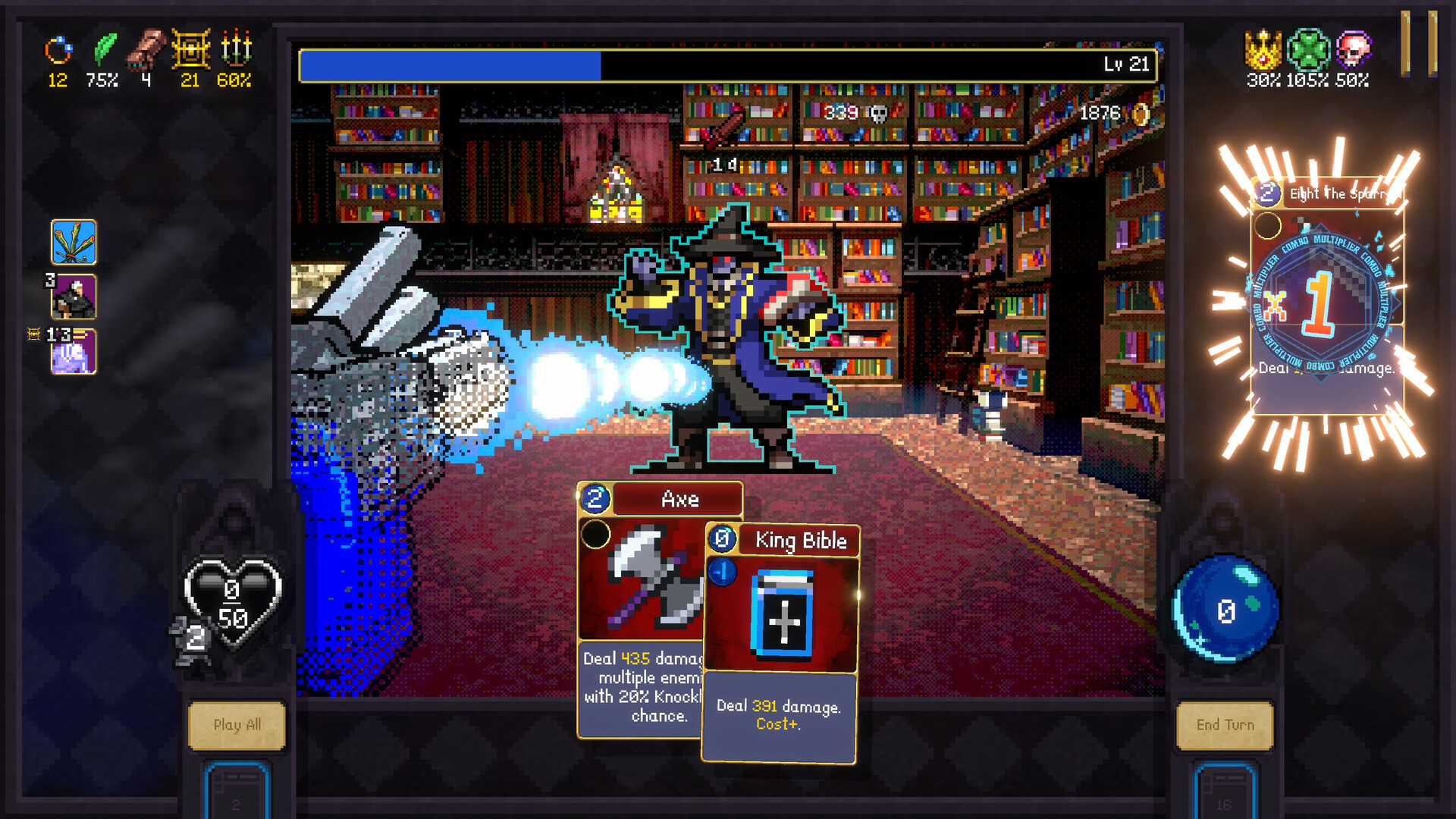
The active hand shows how card order and repeated effects build a combo.Steam
Think in pairings, not isolated cards
Evolutions are built from weapon-plus-passive pairings: a base weapon, a matching support
card, then a stronger evolved form. Pick one or two target recipes early and let that
shape reward decisions. Random passives are how a clean route turns into a hand full of
almost-combos.
Player-reported evolution reference
Use this as a route-planning reference, not as a finished official compendium. The safest approach is to treat each row as a planning target, then confirm the pairing in your current run before spending rare sockets or opening the last chest on a floor. Patch changes, DLC, and balance updates can still change names or trigger rules.
Base weaponRequired passiveEvolved cardRoute valueFailure risk
WhipHollow HeartBloody TearSafer early sustain while the deck is still finding its engine.Do not overinvest if the run already has sustain but lacks scaling.
Magic WandEmpty TomeHoly WandReliable targeted spell pressure for cleaner small-room turns.Can feel low impact if the hand needs area control instead.
KnifeBracerThousand EdgeFast physical pressure when the deck wants one direct finisher.Weak route if draw, mana order, or boss control is already failing.
AxeCandelabradorDeath SpiralArea-clearing route for rooms that punish narrow damage.Do not chase if your passives are already committed to another area plan.
CrossCloverHeaven SwordCrit-leaning payoff when the route has luck or single-target pressure.Patch-check this row before treating it as a boss solution.
King BibleSpellbinderUnholy VespersClose-range safety and rotating pressure for messy rooms.Fails if bosses require burst windows rather than constant contact damage.
Fire WandSpinachHellfireBurst spell line for damage-heavy routes.Do not pick just because Spinach looks generically strong.
GarlicPummarolaSoul EaterEarly safety route when weak openings need contact control.Can slow a run that already clears safely and needs scaling.
Santa WaterAttractorbLa BorraZone-control route for rooms where enemies pile into predictable lanes.Harder to justify if the deck cannot hold enemies in the effect area.
RunetracerArmorNO FUTUREScaling bounce-style pressure when the route wants durable room clear.Do not force if Armor is needed only as survival and not as a recipe piece.
Lightning RingDuplicatorThunder LoopLarge-area burst line for Amount or room-clear plans.Competes with other Amount routes; avoid splitting payoff cards.
PentagramCrownGorgeous MoonHigh-impact clear and growth payoff when the deck can survive setup time.Too greedy if early fights already require emergency cards.
Gatti AmariStone MaskVicious HungerGold-leaning route when economy is already part of the plan.Do not pivot into it if the run is still missing survival or boss damage.
Song of ManaSkull O'ManiacMannajjaWide lane pressure for decks that can handle curse-style risk.Skip if the extra pressure makes normal rooms unstable.
Shadow PinionWingsValkyrie TurnerMovement-leaning payoff for routes that can position deliberately.Bad fit if the fight plan is stationary control or simple burst.
Peachone + Ebony WingsTwo-bird fusionVandalierTwo-card payoff for long runs that can afford delayed scaling.Avoid when the deck needs one immediate answer, not a second setup line.
Phiera Der Tuphello + Eight The SparrowTiragisuPhieraggiLate damage route for decks that can support a larger setup package.Do not chase if the run cannot protect the setup through boss pressure.
Recipe route analysis
If your run needs...Start with these recipesWhyDo not force
Early sustainWhip, Garlic, King BibleThey help the hand survive long enough to find stronger scaling.Do not turn every safe run into a slow sustain deck.
Room clearAxe, Santa Water, Runetracer, Lightning RingThese are better when the problem is enemy volume, not one boss target.Do not split passives across every area recipe at once.
Boss burstKnife, Fire Wand, Cross, PhieraggiThey give the hand a clearer damage job when boss windows are short.Do not ignore control if the boss kills you before the burst turn.
Gold or account progressGatti Amari, Bloody Tear stabilizer, Coin Count routesGold plans need survival first, then a damage source that benefits from the economy.Do not pick economy recipes while the run is already dying.
Give Every Recipe a Route Job
Outside recipe tables are useful when they help you pick a target before the run gets noisy. They become dangerous when you copy the list without checking whether it belongs to Vampire Crawlers, whether the current card text still matches, and whether your weapon still has room to evolve.
Treat each recipe row as a question, not an order. The question is not only "does this weapon evolve?" It is "does this evolution solve the problem my current hand is losing to?"
Outside table gives...Check this firstUse it if...Ignore or downgrade if...
A weapon + passive recipe.The live weapon card, required passive, and open socket state.The pairing is visible in your current run and the weapon still has room for the payoff.The row never mentions sockets or assumes a different auto-battler rule set.
A long list of "must-have" evolutions.Which route job each evolution solves: sustain, room clear, boss burst, control, or economy.Your run is missing that exact job and your passives already point there.The list turns every strong card into a mandatory card.
A gold or farming evolution route.Whether survival, draw order, and boss control are already stable.Greed is added after the hand can win normal rooms without panic upgrades.The route starts with economy before the deck can survive the floor.
A recipe copied from an older chart.Current tooltip text, current passive names, and whether the table mixes Vampire Survivors-only context.The live card text and crawler route still agree with the row.The chart has names or assumptions that do not appear in your current Vampire Crawlers run.
A table that never accounts for sockets, crawler cards, village tools, or the current tooltip is probably describing a different rule set. Read the live card and socket state before committing the run.
Blacksmith and jeweler priorities
Gem Hammer unlocks socketing early in Mad Forest. Stardust Anvil opens the blacksmith
from Teeny Bridge, letting you add sockets to important cards. Lapidary Loupe unlocks
jeweler control around Gallo Tower, where sealing bad gems or increasing key gem odds
starts to matter. Spend those systems on your main route first.
If you cannot explain which card is supposed to carry the next few floors, save the fancy
socket work. Upgrade tools are strongest when they reinforce a plan you already trust,
not when they decorate a hand that is still arguing with itself.
Beginner-safe upgrade rules
Pick a target weapon before spending rare upgrades. Random power is less useful than repeatable power.
Leave evolution room. If a weapon needs an empty slot, do not fill every slot with minor bonuses.
Upgrade cards that improve the whole hand. Draw, sequencing, and mana support can matter as much as damage.
Check passive pairings before committing. A wrong passive can waste a route.
Failure Checks
ProblemLikely causeFix
The evolution never appearsThe weapon is missing its required passive or an empty socketCheck the pairing before filling slots with minor gems
The deck has many upgrades but weak boss damageUpgrades are spread across too many cardsFocus sockets and gems on one or two cards that define the route
A passive clogs the handIt was taken for a recipe that the run cannot completeSkip pairings that do not support your current weapon plan
Short-term power blocks long-term scalingEvery slot was filled before evolution timingLeave room until the upgrade is secured, then add extra gem value later
Official Evolution Context
The official launch notes describe weapon evolutions as part of card customization, while the June 23 update says level-up offers can flag cards that belong to an evolution completed before. The indicator reveals an available relationship; the current floor still decides whether the payoff is worth the slots.
When an evolution signal appearsCheckCommit whenSkip when
A familiar pairing is offered.Does the current hand and route have room to reach the payoff?It strengthens the job already carrying this floor.It needs a new deck shape while pressure is already rising.
An outside recipe list names a pairing.Read the current card text, slot state, and evolution indicator.The live interface agrees and the pairing serves the present route.The list predates the current card text or solves a different deck problem.
The official launch notes explain the evolution system, and the June 23 update explains the offer indicator. Pair those rules with the current card text and open socket state.
Gem Investment: Read the Condition Before the Rarity
Separate a gem's visible property, trigger condition, duration, and rarity into different questions. That is a better starting point than treating every rare gem as an automatic upgrade. Read the live tooltip before making a numeric decision.
Before socketing a gemCheckCommit whenHold when
PropertyWhich live stat or effect the gem changes.It strengthens the card that currently carries damage, control, or survival.It only looks broadly useful but has no route job.
ConditionWhat must happen before the tooltip effect applies.Your normal turn already meets that condition without forcing bad plays.The route would need new filler just to turn the gem on.
Duration or timingWhether the effect matters during the room or boss window you keep losing.The benefit arrives before the run's repeated failure point.The effect starts after the dangerous part is already over.
RarityThe actual current tooltip, not an old probability claim.The gem also passes the property and condition checks.Rarity is the only reason to replace a working socket.
A rare gem still needs a job. Keep the current socket when the replacement adds rarity without improving the route's damage, control, or survival window.
Related guides
See Core Mechanics for combo sequencing and
Cards Reference for recipe and role notes. If you are farming
gold, the Gold Farming Guide explains why Bloody
Tear is a useful early stabilizer before Coin Count takes over.
Upgrade habit: if a weapon has an evolution route, leave one slot open until
the evolution is done. After that, use extra sockets and gems to push the evolved card harder.
Your run is not dead because you skipped a shiny socket once. The bigger mistake is a
panic upgrade that clogs the route right before the payoff. Hold the slot, finish the
pairing, then spend the extra power with a cleaner hand.