
Romestead guide
Romestead Resource Hauling Guide
In Romestead, resource hauling is not background inventory work. Treat rocks, lumber, carts, and storage routes as the settlement's main engine: keep repeated materials close to the stations that use them, assign one reset point before night, and stop opening new crafting projects until the current supply route actually works.
Why Hauling Matters
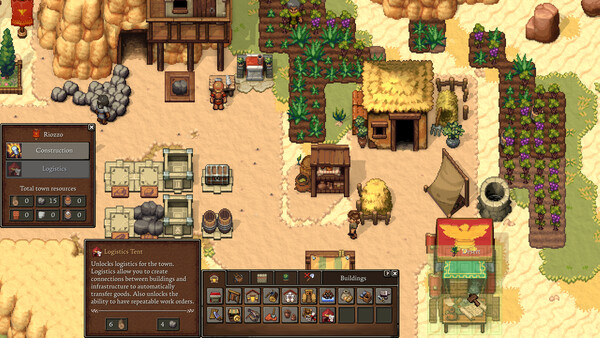
Romestead turns physical resource handling into part of the route: players pick up, carry, and throw rocks and lumber instead of solving every problem through a normal backpack inventory. That makes base layout and travel distance part of the strategy. A town can have the right station and the right raw material, but still feel slow if those materials are dropped far from the worker, cart, or crafting target that needs them.
The safe early rule is simple: do not judge a crafting chain until you have checked the route feeding it. If Blacksmith, Leatherworker, Farmstead, or another work area feels idle, the first suspect is usually material flow, not the station itself.
The trap is celebrating the pile. A giant stockpile feels good for about five seconds, then the station still sits idle because the useful material is three screens away or mixed into clutter. If this is happening, stop gathering more. The recovery move is to move the next repeated input beside the job that actually needs it.
Hauling Priority Table
Best Early Storage Layout
Start with one compact town core, then create small storage zones around repeated actions. A building-material spot should sit near active construction. A crafting-input spot should sit near the station chain using those inputs. A return pile should exist where explorers and gatherers can drop resources quickly before taking another job.
This is especially important in co-op. If every player uses a different drop point, the base lead cannot see what the settlement can actually build next. If everyone uses one huge pile, each station may still waste time walking. The middle ground is job-based storage: one place for construction inputs, one place for station inputs, one place for expedition returns.
First Hauling Route to Use
For a new settlement, make the first hauling route boring on purpose. Move the materials that feed survival, active construction, and the next useful station before hauling anything that only looks interesting. If the base is not yet stable, delay distant loot sorting until food, basic building material, and tool access have a clean place to land.
Think of hauling like the belt work in a factory game, except the belt has legs and gets distracted by nightfall. The goal is not to move everything. The goal is to make the next important craft, repair, or build happen without a scavenger hunt.
Solo vs Co-op Hauling
When to Build the Next Station
A new station is only a real upgrade if the settlement can feed it. Before building another station, ask three questions: where will its raw inputs land, who moves those inputs, and what existing job will slow down because of the new route? If the answer is unclear, improve the current hauling loop first.
This is why early station order should be conservative. Romestead has deep crafting and artisan systems, but opening too many chains before storage is readable creates the same problem as exploring too far: the map looks busy while progress slows down.
30-Second Bottleneck Check
- Look at the idle station. Decide whether it is waiting on raw input, a finished part, space, or a player action.
- Check the nearest pile. If the needed input exists but is far away, the problem is hauling, not crafting.
- Find the repeated walk. Any route the team repeats several times should get a closer storage spot or handoff point.
- Close one project. Pause the least useful open build until the main route is working again.
- Call a reset. If tools or materials are scattered before danger, bring them back before starting another trip.
Route Ownership Ladder
If the same hauling problem returns after every session, the missing piece is usually ownership, not another storage box. Give the route a job, a caller, and a stop condition. That turns hauling from background busywork into a readable settlement system.
Minimum-Cost Base Reset
If the base is already messy, do not rebuild everything. Pick one active objective, move only the materials needed for that objective into one visible pile, and ignore unrelated clutter until the objective is complete. In co-op, the base lead should call the objective while one player hauls and one player keeps defense or exploration from interrupting the reset.
This reset is not about making the town pretty. It is about turning a confusing pile of resources into one working route. Once the route works, the next layout decision becomes much easier: keep the storage where it is if the station stays active, or move it closer to the next repeated job.
If the group keeps duplicating work, do not solve it with another station. Solve it with ownership. One player names the current objective, one player hauls for that objective, and everyone else stops "helpfully" creating new piles until the route produces something usable.
Official Logistics Fault Check
The official Steam page makes physical hauling part of the game: heavy resources are carried individually or moved with a cart train. But a long route is not the only possible cause of an idle chain. The stable 0.25.1_12 hotfix fixed one specific bug that stopped logistics from transporting items from claypits or lumberyards, and the note says rebuilding may be required.
Failure Checks
What to Check Next
Romestead is in Early Access, so the best hauling route can change as recipes, logistics, enemy pressure, and god bonuses are patched. When a town slows down, compare gathering time, walking routes, station inputs, and night resets. The slowest part of that chain is the next thing to redesign.
Patch Context
How to use this: if the base has resources but still feels slow, assume the problem is movement before production. Look for long walks, scattered storage, blocked carts, and workers grabbing the wrong job.
Patch caution: when recipes, storage behavior, carts, night pressure, or god bonuses change, retest hauling before you blame the whole settlement plan.
Related Guides
Start with the Romestead Beginner Guide if the whole settlement is still unstable. Use Logistics Tent and Automation Timing when repeated hauling becomes the reason to push Guardian of Minerva. Use the Night Defense Guide if tools, resources, or players keep getting scattered after dark. If you play with friends, use the Co-op Roles Guide to decide who handles hauling, exploration, crafting, and night resets. Check Romestead Updates after patches because logistics and crafting pressure can change during Early Access.