


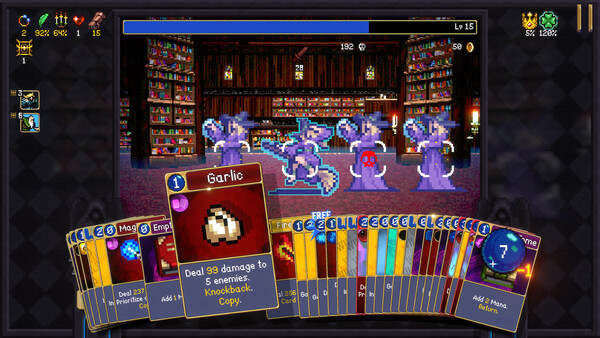
Updated for the June 23 Version 1.5 patch; sources checked October 3, 2026. These are conditional build routes, with their setup costs and failure points, rather than a character tier list.
Choose the trigger you can actually feed
A crawler card has an immediate effect and a lingering trigger. Those are separate reasons to play it. Gennaro, for example, can provide Amount when played, but his red-card trigger deals damage. That is different from Mortaccio repeatedly gaining Amount from blue cards.
The distinction changes your next pick. A strong red attack does not activate Pugnala’s yellow-card draw on its own. A purple Tome supports Giovanna’s draw trigger while also producing mana. A blue defensive card can help both Mortaccio and Poe, provided those crawlers are active.
| Active crawler | Trigger to build around | Cards that supply it | What it does not fix by itself |
|---|---|---|---|
| Pugnala | Yellow plays draw cards | Spellbinder, Attractorb, Spinach | A hand without mana or the next combo step |
| Giovanna | Purple plays draw cards | Empty, Light and Weighty Tomes | Enough damage to finish the encounter |
| Poe | Blue plays draw cards | Armor, Golden Armor, Pummarola | The need to activate and sustain the crawler |
| Mortaccio | Blue plays increase Amount | Armor and recovery cards | Access to those cards or a suitable attack |
| Suor Clerici | Blue plays add Recovery | The same blue cards used with Poe or Mortaccio | Immediate healing during a lethal action |
The Version 1.5 community reference lists these roles. Jay Dunna’s April Pugnala walkthrough identifies Pugnala’s yellow draw at 0:20 and Giovanna’s purple draw at 1:30; Tenkiei’s beginner walkthrough covers Poe’s blue draw at 2:39. Recovery pays after the encounter; treat Clerici’s immediate healing effect separately from her lingering trigger.
Pugnala, Giovanna and Poe: draw from three colors
This party has a straightforward appeal: useful yellow, purple and blue cards can replace themselves while contributing their normal effects. The community build that uses Pugnala as the main crawler starts with her guns, a Tome and Spellbinder, then uses the supporting crawlers to keep finding the next play.
The setup still has to happen. Activate your crawlers before expecting their passive draws, and use Spellbinder to extend their remaining activations. A pile of yellow cards does not draw through Pugnala while she is still sitting in the deck.
For the first few rewards, look for the missing part of this small package:
- Tomes fund paid plays and activate Giovanna’s purple trigger.
- Spellbinder supports crawler duration while activating Pugnala’s yellow trigger.
- Attractorb supplies an immediate draw effect as well as a yellow trigger.
- A playable Wild bridges the point where your consecutive costs run out.
- The starting guns, or another supported weapon, give the turn a damage payoff.
Do not collect every item before trying to deal damage. If the current hand can finish the encounter safely, use that line. The package is a way to make the next hand more reliable, rather than a checklist that must be completed on every floor.
Fix the opening hand before extending the late turn
Quick Draw on Attractorb addresses a specific failure: the deck contains draw, but the opening hand cannot find it. Wild on that Attractorb addresses a different failure: you can find cards, but cannot insert the draw play into the current cost sequence. Attractorb starts without gem sockets, so this two-gem setup needs both socket upgrades at the Blacksmith; it is not an early-run free upgrade. Players discuss this Attractorb pairing and draw-gem Tomes as consistency tools.
A Draw gem on a Tome is a useful intermediate option when Wild gems are not readily available. It puts card access on a mana-producing play instead of requiring two separate pieces. Choose between these upgrades by the first thing that actually fails: opening access, card replacement, mana or sequence.
Bracer improves Hand, the opening draw on later turns. It does not immediately pull the missing Tome into your current hand. Magnet improves draw effects instead. The stat reference separates those jobs, which prevents spending an upgrade on the wrong symptom.
Make a Scene and Chain Link solve different problems
Make a Scene triggers crawler abilities at the start of a turn. With active draw crawlers, that can produce additional cards; it is not an unconditional “three extra starting cards” effect for any party. Its value depends on which crawlers you have active.
Chain Link instead keeps a combo across turn endings. It is useful when the hand needs another turn, especially if continuing now would overuse an essential card. It does not supply the missing mana, activate a crawler or protect you from the enemy action. The player discussion about long combos and card breaking explains why a multi-turn chain can be more practical than literal infinite reuse.
Choose Make a Scene for recurring trigger value or Chain Link for preserving a sequence you can safely continue. Neither choice makes every opening draw reliable on its own.
When Poppea is the better third slot
Poe fits a deck that is already playing useful blue cards. If those plays are scarce and crawler duration is the repeated problem, Poppea offers a different route: her yellow trigger adds Duration, so the same yellow-heavy turns that feed Pugnala help keep the party active.
Poppea also brings Song of Mana into the build. The important distinction is that Song of Mana is a 4-cost purple card that generates a Raw Mana Wild card. Do not plan the turn as if Song of Mana itself were a cheap Wild. You need to afford its play before using the generated card to regain mana and reconnect the sequence.
That makes Pugnala–Poppea–Giovanna a reasonable alternative when you want yellow-duration support plus purple draw. It trades Poe’s blue draw for another way to maintain activations and generate a Wild. The generated-Wild interaction is described in the party-selection discussion and a Poppea-led build.
Keep a usable damage line while you assemble this support. Phieraggi is a possible evolution for Pugnala’s two guns when the needed Tirajisú and evolution opportunity are available. It is not a reason to postpone every useful attack until the evolution appears. Use Weapons and Evolutions for the combination requirements.
Mortaccio, Poe and Clerici: one blue card serves three jobs
The developer’s character-trigger explanation gives this exact party example: an Armor play can trigger draw, Amount and recovery through Poe, Mortaccio and Suor Clerici. It is a concrete reason to select them together.
Mortaccio supplies the scaling, Poe helps replace the blue card, and Clerici improves healing after the encounter. This party still needs mana, adequate opening access and attacks. Its advantage is that defensive plays also advance the damage plan, rather than requiring a separate set of speculative buffs.
With the crawlers active, the basic card sequence is easy to inspect:
- Bone costs 0 and starts the chain.
- Golden Armor costs 1, adds protection and triggers the active blue-card abilities.
- A 2-cost attack such as Holy Wand provides a follow-up against a tougher target.
A Reverse Combo gem on Golden Armor adds another branch: Bone 0 → Golden Armor 1 → another Bone 0. From there, an ordinary 1-cost play can continue the ascent. This is a practical way to give a low-cost attack combo value without needing a Wild for that one step.
There is a preparation cost: Golden Armor begins without a gem socket. Add one through the Blacksmith before treating that Reverse setup as available. Check actual sockets before planning multiple gems on any card.
The Mortaccio build write-up also identifies a limitation: Bone has fewer bouncing opportunities against a lone boss. Keep a single-target answer rather than assuming a room-clearing result will carry unchanged into that fight. Holy Wand is one option for the sequence above, not a mandatory weapon.
Improve the part that is falling behind
- Crawlers run out of activations: look for Spellbinder or other Duration support before adding more blue trigger plays.
- Blue cards build Amount but the hand dries up: improve immediate draw or access to Poe, rather than buying still more Amount.
- Crowds die but the boss survives: improve a suitable finishing attack, its damage gem or the combo that reaches it.
- Defense vanishes between turns: Your Shield My Liege is the Arcana to consider for retaining armor. It does not remove the need to check boss attacks.
Damage gems such as Double or Triple Damage can improve an existing attack without adding another card to the deck. Avoid chasing both just because they look strong: slot space, the next enemy and whether the attack can reach its target still matter.
When a farming goal changes the party
Krochi can add revival progress from Wild plays. O’Sole’s flower-generated healing cards provide another Wild supply, with his red-trigger Luck offering a separate benefit. These are reasons to change the party for a farming goal, not proof that either character is always the strongest combat choice.
Coin Count belongs to that more specific gold-to-damage plan. Mild is not a general solution for a draw deck: keeping a card in hand comes with breaking the combo. If you are preserving a long chain, that cost matters. See Gold Farming for the dedicated route.
Check the mode before copying a prepared build
Version 1.5 changed Jeweller rarity handling and added a display of which chests can contain each gem. Old launch-era instructions to manipulate rarity should be checked against that display, particularly when hunting an Evolution gem. The official update also disables the Jeweller in Endless Mode, so a sealed-pool build from normal play is not a guaranteed Endless opener.
If you do not yet have these crawlers or support systems, stay with the part of the route you can use. Imelda, Pasqualina and Gennaro can teach growth, larger opening hands and direct red-card pressure without requiring a three-crawler engine. The Crawler Unlock Guide and Beginner Route cover that progression.
When a run stalls, identify the first missing action. Could you activate the crawler? Did the next card match its color? Did you have mana and a combo-safe sequence? Did the attack finish the target before cracks or the boss counter intervened? That diagnosis tells you which card or support slot to change. For worked mana-order examples, use Core Mechanics.
Sources & research
Written sources and creator commentary transcripts inform the guide. April creator material predates version 1.5; the gameplay baseline is June 23, 2026 version 1.5. Death Parade remains a development preview. Sources checked October 3, 2026.
- Version 1.5 community reference ↗
- Jay Dunna’s April Pugnala walkthrough ↗
- Tenkiei’s beginner walkthrough ↗
- community build that uses Pugnala as the main crawler ↗
- Attractorb pairing and draw-gem Tomes ↗
- stat reference ↗
- player discussion about long combos and card breaking ↗
- party-selection discussion ↗
- Poppea-led build ↗
- character-trigger explanation ↗
- Mortaccio build write-up ↗
- official update ↗